
Last updated September 21, 2026
Full 25-point door and opener safety check with every visit - springs, cables, rollers, tracks, and your LiftMaster or Chamberlain opener included
You get a price before we start. It does not change when the truck arrives.
DIY vs Professional Garage Door: The Fremont Homeowner’s Decision Guide
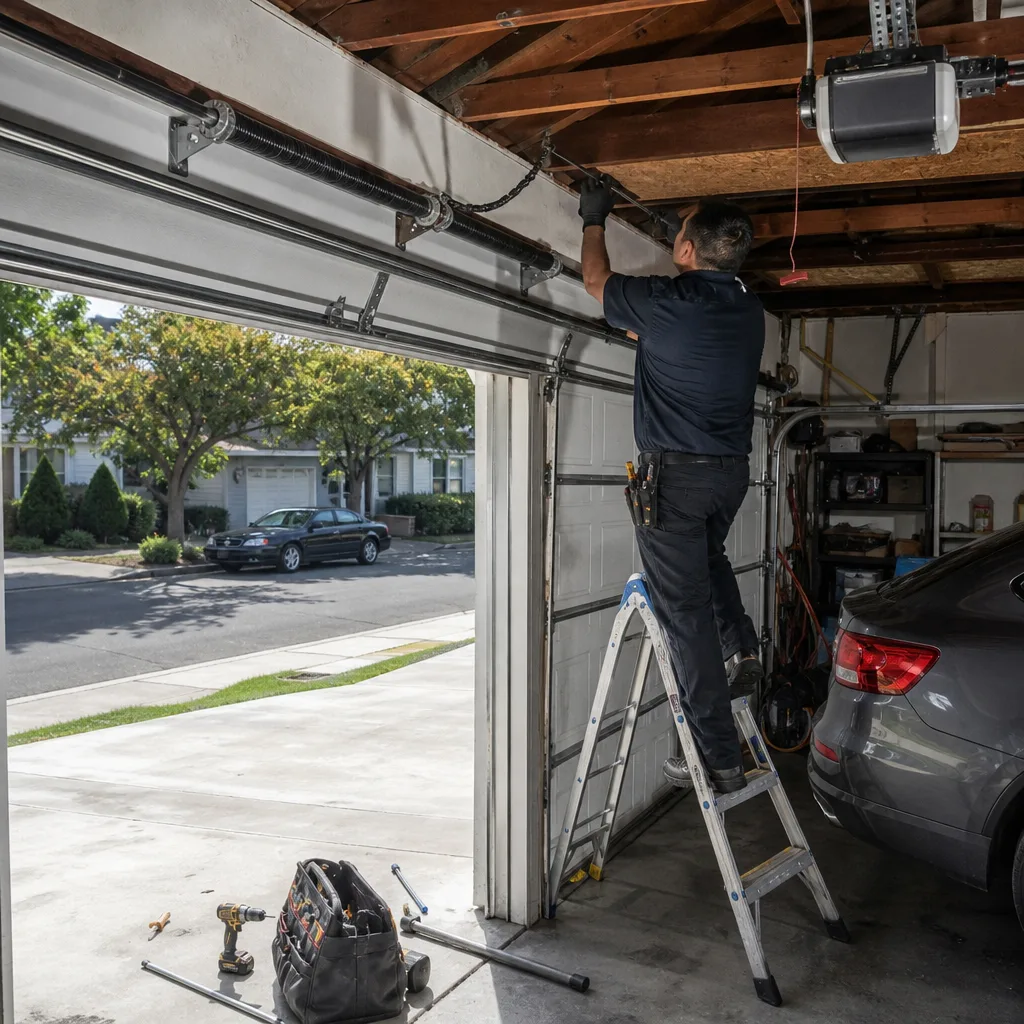
Torsion spring replacement injures approximately 20,000 Americans annually according to CPSC data. Not because homeowners are careless, but because a standard residential torsion spring stores 50-100 ft-lbs of torque, and the winding bars required to release it safely are not sold at Home Depot. In Fremont, where many homes in the Mission San Jose and Warm Springs areas were built during the 1970s and 1980s garage door boom, we’re still seeing original hardware that’s well past its cycle life. This guide draws a hard mechanical line between what you can safely handle yourself and what requires a technician with calibrated tools, written insurance documentation, and a clear understanding of California’s life-safety compliance requirements.
Quick Answer
Most Fremont homeowners can safely handle photo-eye alignment, weather seal replacement, roller lubrication, and remote programming in under 30 minutes with basic tools. Any task involving torsion springs, cable drums, or structural panel realignment requires professional equipment and carries injury risk that makes DIY inadvisable regardless of skill level. Work affecting auto-reverse or entrapment protection systems should be documented by a licensed contractor for homeowner insurance purposes in California.
Table of Contents
- The Mechanical Line: What’s Actually Safe to DIY
- The Tools You Need vs. The Tools Professionals Carry
- DIY-Appropriate Tasks: Cost, Time, and What Goes Wrong
- Tasks That Require a Professional: Why the Risk Isn’t Worth It
- California Compliance: Insurance, Permits, and Documentation
- How to Prepare for a Professional Service Call
- Cost Comparison: DIY Parts vs. Professional Repair in Fremont
- Common Mistakes to Avoid
- When to Call a Professional
- Frequently Asked Questions
- The Bottom Line
The Mechanical Line: What’s Actually Safe to DIY
We’ve found that the DIY vs. professional question frustrates homeowners because most guides treat it as a matter of confidence or budget. It isn’t. There’s a specific mechanical threshold, and it sits at the boundary between “adjustment” and “tension.”
Tasks on the safe side of that line don’t store energy. They don’t support the door’s weight. They don’t require tools that could slip and release a sudden force. On the other side, you’re dealing with components that can cause serious injury even when handled correctly by someone without proper training.
Here’s the breakdown we use on every service call in Fremont:
Safe for most homeowners:
- Photo-eye (safety sensor) realignment - no stored energy, no weight-bearing parts
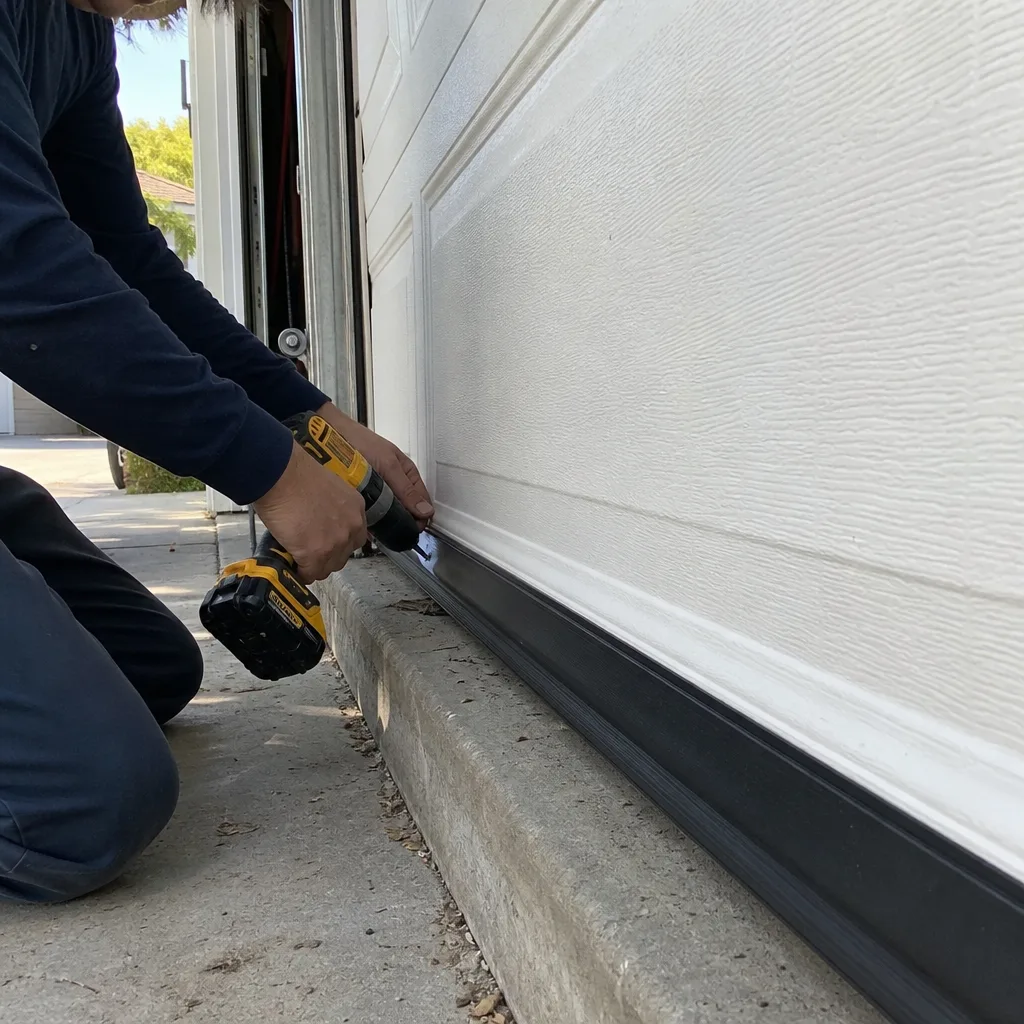
- Weather seal replacement on the bottom of the door - the seal is passive, the door is fully open and supported
- Roller and hinge lubrication - maintenance, not repair; the door stays in position
- Opener remote programming - electronic configuration, no mechanical load
- Manual release handle operation - designed for homeowner use during power outages
Never DIY:
- Torsion or extension spring replacement - stored torque can cause laceration, amputation, or death
- Cable drum or cable replacement - cables are under tension and can whip unpredictably
- Bottom bracket replacement - these brackets anchor the lifting cables under load
- Structural panel realignment or replacement - a 16×7 steel panel can weigh 150+ pounds
- Opener logic board or limit switch replacement - electrical work with line voltage and motor load
In the Niles district and around Central Park, we see a lot of homeowners who are comfortable with general home maintenance. That confidence is useful for the first list. It doesn’t transfer to the second.
The Tools You Need vs. The Tools Professionals Carry
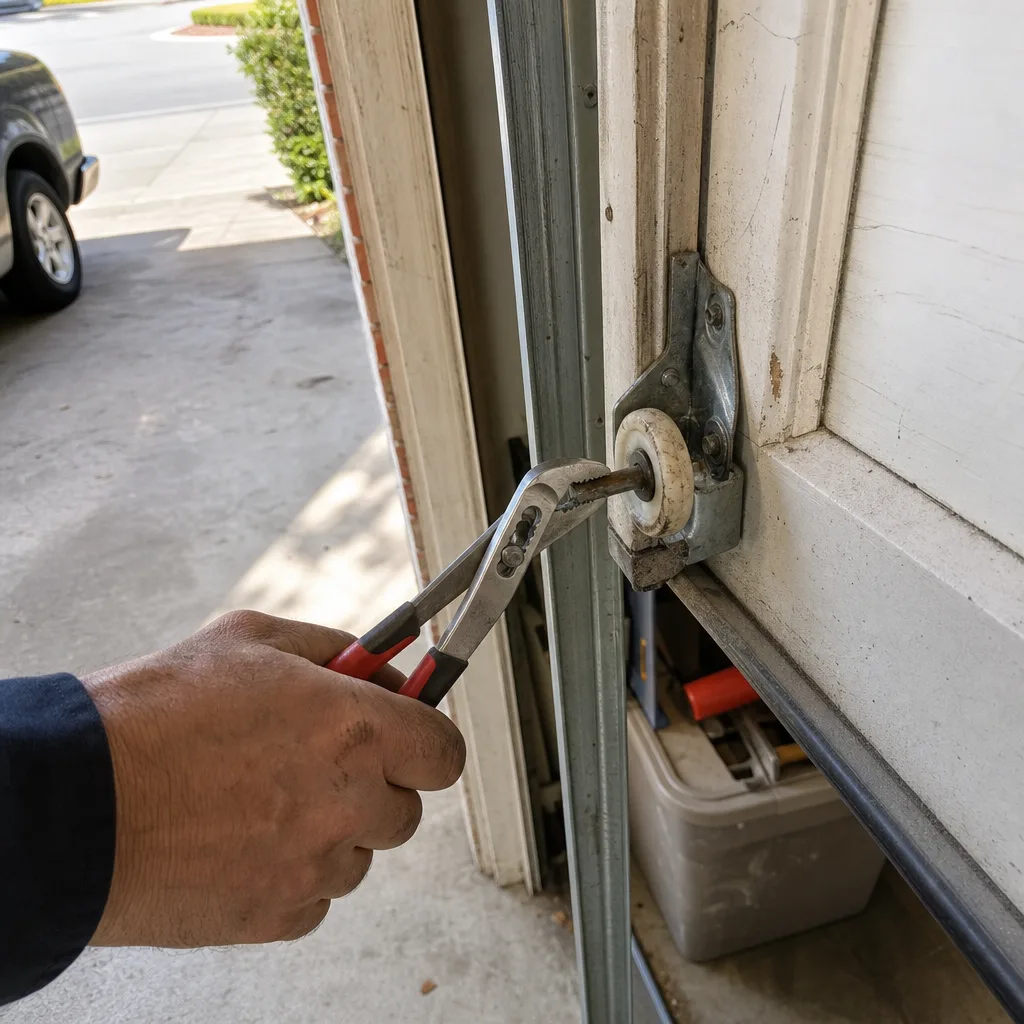
The injury data makes more sense when you look at what’s actually in a technician’s truck versus what’s in a typical Fremont garage toolbox.
For safe DIY tasks, you need:
- Clean rag and mild detergent (for photo-eye lenses)
- Measuring tape (for weather seal sizing)
- Silicone-based garage door lubricant - not WD-40, which attracts dust
- Stepladder, 4-foot minimum
- Owner’s manual for your opener model
For professional-tier tasks, a technician carries:
- Winding bars - solid steel, precisely sized to the spring’s winding cone (typically 1/2-inch or 7/16-inch diameter, 18 inches long). These are not screwdriver substitutes. Using a screwdriver, pliers, or any other tool in a winding cone is the single most common cause of serious injury.
- Torsion spring winding cones and stationary cones, matched to the specific wire diameter, inner diameter, and length
- Cable pullers and proper cable grips
- Torque wrench calibrated in inch-pounds for setting spring tension
- Locking pliers (vise grips) rated for the specific load, used to secure the torsion tube
- Level and track alignment gauges
- Voltmeter for opener electrical diagnostics
The critical point: you cannot improvise the professional tools. A screwdriver in a winding cone will slip. It always slips eventually. When it does, the cone spins with the full stored energy of the spring. We’ve documented the aftermath in our photo records - bent tools embedded in garage walls, lacerated hands, and worse.
Clause 4 of The Haven Standard is why our technician photographs the failed part before quoting a replacement. The customer sees the torsion spring, the cable fray, or the cracked bottom bracket before any price is discussed. That documentation exists because we built this company on the principle that evidence replaces persuasion.
DIY-Appropriate Tasks: Cost, Time, and What Goes Wrong
Here’s what each safe task actually involves, with realistic cost and failure modes.
1. Photo-Eye Realignment
The photo-eyes are the two small boxes near the floor on either side of the door track. They transmit an invisible beam. If the beam breaks, the door won’t close.
Time: 10-15 minutes
Part cost: $0 (adjustment only); $25-$45 per eye if replacement needed
What goes wrong: Misalignment persists, or the eyes are bumped repeatedly by storage items. In Fremont’s older garages, particularly in the Glenmoor and Cabrillo areas, we see photo-eyes mounted on brackets that have loosened from decades of vibration.
Steps:
- Clean both lenses with a dry cloth - dust and spider webs are the most common cause of false obstruction signals
- Check that both indicator lights are steady (not blinking). A blinking light means misalignment
- Loosen the mounting bracket wing nut, adjust the eye until the light steadies, then retighten
- Test the door - it should close fully. If it reverses, repeat the alignment
Realistic mistake cost: If you can’t achieve steady lights, the eyes may be failing. A technician call for diagnosis and replacement runs $120-$180 in Fremont.
2. Weather Seal Replacement
The rubber or vinyl strip on the bottom of the door keeps water, dust, and pests out. In Fremont, where winter rains come in concentrated bursts and summer temperatures can exceed 90°F, seal deterioration is accelerated.
Time: 20-30 minutes
Part cost: $15-$35 for standard vinyl or rubber seal; $40-$75 for heavy-duty or bulb-style seals
What goes wrong: Wrong profile purchased, seal slides out of track, or the old seal has adhered to the retainer and tears during removal.
Steps:
- Raise the door fully and secure it - never work under a partially open door
- Remove the old seal by pulling from one end; a flat-head screwdriver can help release stuck sections
- Measure the door width and purchase the correct seal profile (T-style, bead-style, or bulb-style - check your retainer channel)
- Lubricate the new seal with dish soap and slide it into the retainer from one end
- Trim excess and test door operation
Realistic mistake cost: Wrong profile means a second trip to the hardware store. Damaged retainer requires professional replacement at $180-$280.
3. Roller and Hinge Lubrication
This is maintenance, not repair, but it’s the most neglected task and the source of most “my door is noisy” calls we get in Fremont.
Time: 15-20 minutes
Part cost: $12-$18 for proper garage door lubricant
What goes wrong: Using WD-40 or grease that attracts dust, creating abrasive paste; lubricating the track (which should stay dry); or missing seized rollers that need replacement.
Steps:
- Close the door and disconnect the opener (pull the red release handle)
- Apply silicone or lithium spray to each roller bearing, each hinge pivot point, and the torsion spring (if visible - do not touch, just spray)
- Wipe excess from all surfaces
- Manually lift the door halfway - it should stay in position. If it drifts, the spring balance is off; that’s a professional call
- Reconnect the opener and test
Realistic mistake cost: Minimal for lubrication errors. If you discover a seized roller or broken hinge during the process, replacement requires a technician - $95-$145 per hinge/roller set in Fremont.
4. Remote Programming
Most modern openers use rolling-code technology. The process varies by manufacturer.
Time: 5-10 minutes
Part cost: $25-$55 for OEM remote; $15-$30 for compatible
What goes wrong: Wrong remote frequency, failure to clear old codes, or opener logic board issues that prevent programming.
Steps:
- Locate the “Learn” button on the opener motor unit - typically behind the light cover
- Press and release the Learn button; the indicator light will glow for 30 seconds
- Press the desired button on the remote within 30 seconds
- The opener light should flash or click to confirm
- Test the remote
If the Learn button doesn’t respond, or if multiple remotes fail, the logic board may need replacement. That’s a Garage Door Opener Repair & Installation in Fremont service call.
Tasks That Require a Professional: Why the Risk Isn’t Worth It
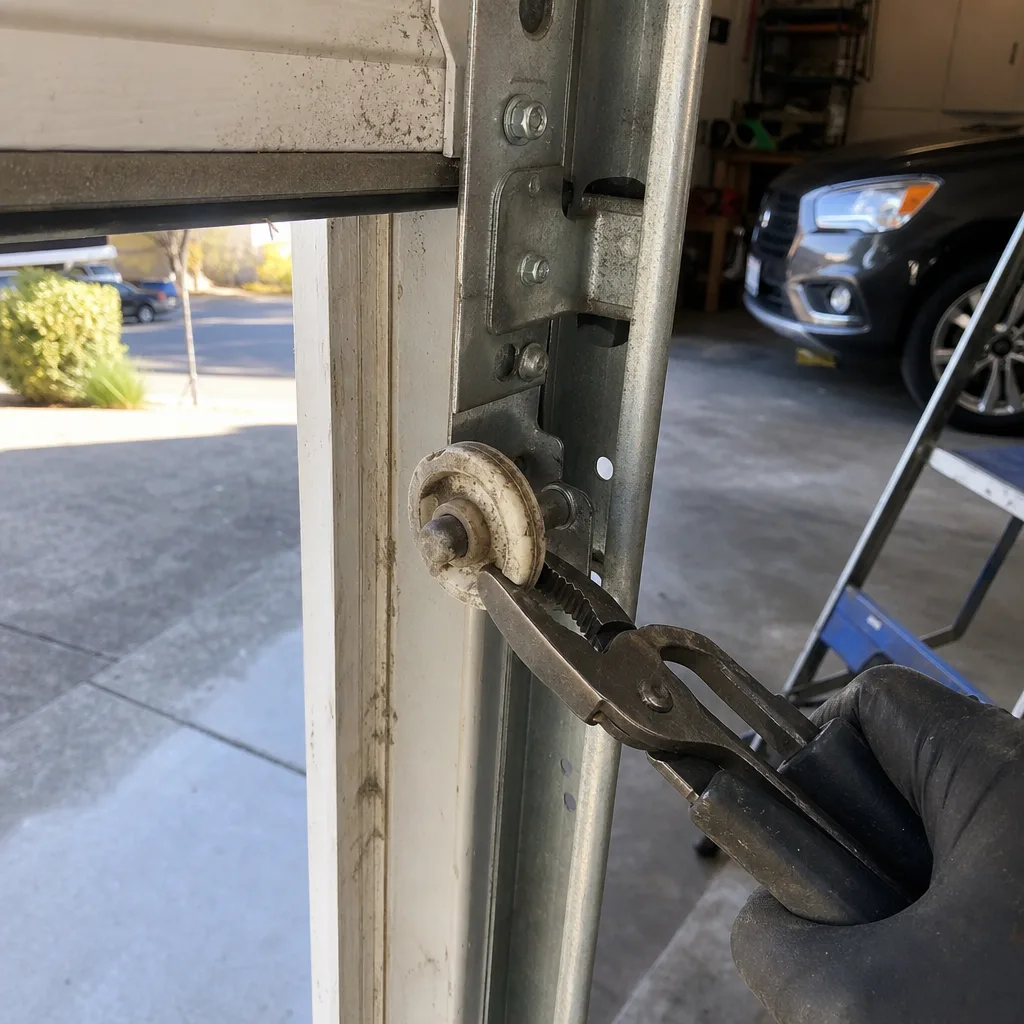
Some garage door work isn’t difficult in the sense of requiring advanced skill. It’s dangerous in the sense that the physics involved exceed what human reflexes can manage when something goes wrong.
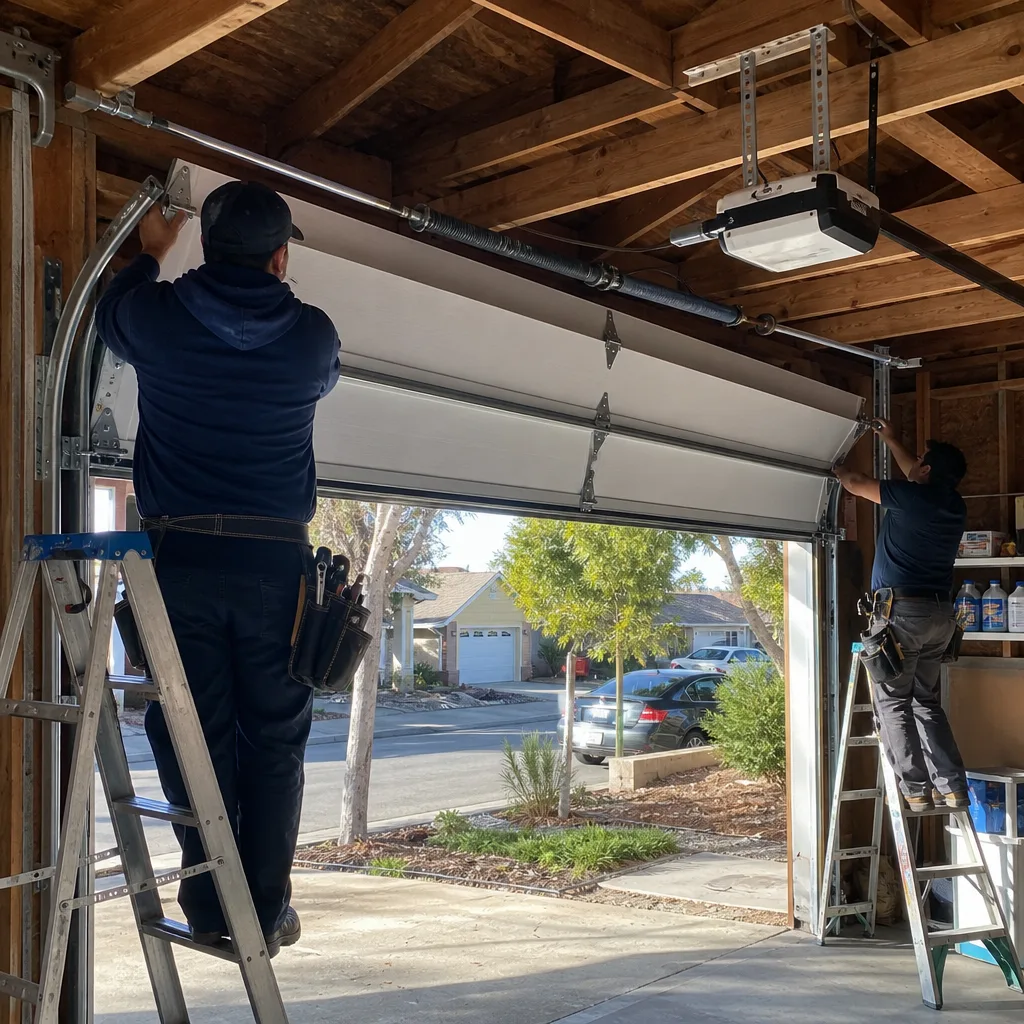
Torsion Spring Replacement
A standard 2-car garage door in Fremont uses a torsion spring with 0.225-inch to 0.250-inch wire diameter, wound to 7.5-8.0 turns. Each turn stores roughly 10-15 ft-lbs of torque. The total stored energy is comparable to a coiled snake that can release in a quarter-second.
The winding process requires:
- Two winding bars inserted simultaneously - one to add tension, one to hold position
- Quarter-turn increments, with the off bar securing the cone between each step
- Precise counting of turns, matched to door weight and drum size
- Proper set screws torqued to specification on the winding cone
An error in any step - wrong bar size, miscounted turns, loose set screw - can release the spring. We’ve seen broken wrists, facial lacerations requiring stitches, and a garage door that launched upward with enough force to bend the top section. The CPSC data isn’t abstract.
Cost in Fremont: $180-$340 for standard torsion spring replacement, including both springs (they should be replaced as a matched pair even if only one failed). Same-day service is available from Garage Door Repair in Fremont providers.
Cable and Cable Drum Work
The lifting cables run from the bottom bracket, over the cable drum at the end of the torsion tube, and anchor to the drum. When a cable frays or slips off the drum, the door becomes unbalanced.
The danger isn’t obvious until you understand that the cable is under tension even when the door is closed. The torsion spring is still wound, holding the door’s weight. Releasing that tension to access the cable requires the same winding bar procedure as spring replacement.
Additionally, cable drums have specific groove patterns matched to door height. A 7-foot door uses a different drum than an 8-foot door. Installing the wrong drum causes uneven lifting and premature wear.
Structural Panel Realignment
Steel garage door panels are not light. A 16×7 insulated panel can weigh 25-35 pounds. The entire door assembly may exceed 200 pounds. When panels are damaged by vehicle contact or have separated at the hinges, the door’s weight distribution shifts.
Realigning panels requires:
- Supporting the door in a partially open position safely
- Loosening multiple hinge points simultaneously
- Repositioning while maintaining alignment across the full width
- Retorquing to specification without over-tightening
A door that slips during this process falls with its full weight. We’ve responded to calls in the Ardenwood and Weibel areas where homeowners attempted panel repair and ended up with a door off the track, damaged vehicle, or worse.
Opener Electrical and Logic Board Work
Modern openers contain line-voltage circuitry, motor controllers, and safety system electronics. The limit switch - which tells the opener when the door is fully open or closed - requires precise adjustment. The force settings, which control how much resistance triggers reversal, must meet UL 325 standards.
Incorrect force settings can cause:
- Door that doesn’t reverse on obstruction (entrapment hazard)
- Premature reversal, preventing full closure
- Excessive motor load, burning out the opener
California requires documented compliance testing for these safety systems. A homeowner adjustment, even if technically correct, lacks the documentation that insurance and liability considerations may require.
California Compliance: Insurance, Permits, and Documentation
This is where the DIY vs. professional question shifts from mechanical to legal. California doesn’t require a building permit for routine garage door repair, but it does regulate garage doors as life-safety systems under several frameworks.
Auto-Reverse and Entrapment Protection
Since 1993, federal law (UL 325) has required automatic garage door openers to reverse direction when encountering an obstruction. California adopted these standards and added state-level requirements for photoelectric sensors on all new installations.
If your garage door injures someone - a child, a pet, a visitor - and the auto-reverse system is found non-functional, your homeowner’s insurance will investigate whether the system was properly maintained and documented. A licensed contractor’s service record, with written scope and test results, provides that documentation. A DIY repair does not.
What to keep after any professional service:
- Written scope of work, signed by both parties
- Invoice with technician license number
- Documentation of safety system testing (force and reverse)
- Photo record of findings and completed work
- Warranty terms in writing
At Servo Garage Doors Fremont, every job closes with a documented photo record delivered to the customer - the same evidence the technician saw, tracing back to the founding rule from 2015. The 365-Day Done Right Promise means if a repair is not right, we make it right; the terms are on the page, not a handshake.
HOA and Neighborhood Requirements
In Fremont’s newer developments, particularly around the Pacific Commons and Innovation District areas, homeowners associations often require approved contractor work for exterior modifications. Even a garage door color change or window insert installation may need HOA approval and licensed installation. Check your CC&Rs before any replacement work.
How to Prepare for a Professional Service Call
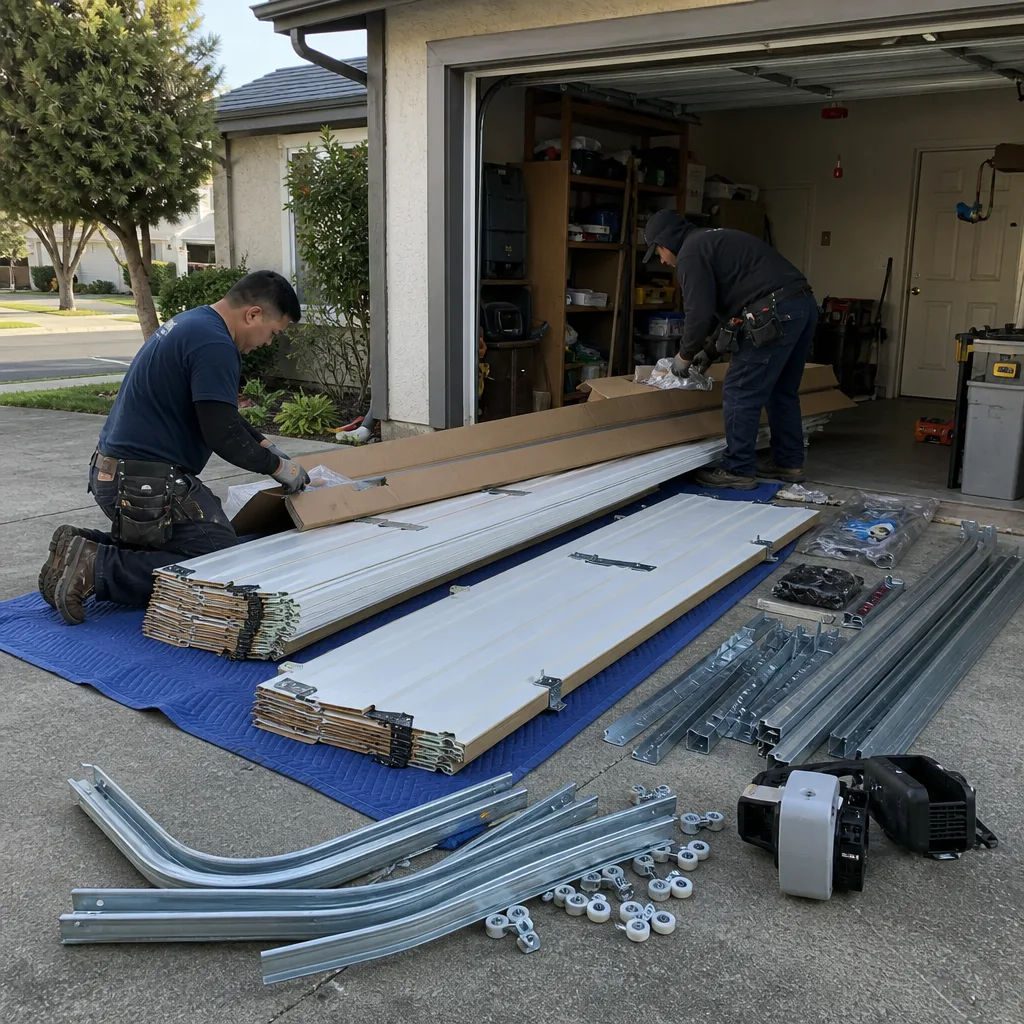
Whether you’ve attempted DIY and hit a wall, or you’re calling from the start, preparation improves the outcome and protects you from pricing ambiguity.
Before the technician arrives:
- Take your own photos of the problem area - the failed spring, the frayed cable, the damaged panel. These are your baseline for comparison
- Note the door dimensions (width and height), manufacturer if visible, and approximate age
- Clear vehicles and storage items from the garage to provide working space
- Test the opener manually - disconnect it and try lifting the door. If it won’t stay at half-height, mention this when scheduling
- Gather any previous service records or warranties
When the technician arrives:
- Ask for license verification - California requires C-61/D-49 (Garage Door and Automatic Gate) or C-10 (Electrical) for opener electrical work
- Request that the scope and price be written before work begins
- Confirm what documentation you’ll receive - photos, test results, warranty terms
- Verify that the technician will test all safety systems and document compliance
This is standard practice under The Haven Standard. Clause 1 requires a flat, written price and written scope before any work starts. No exceptions. The customer should know exactly what leaving looks like before anyone touches a tool.
Our Free Second Opinion offer applies to any competing written estimate a customer brings in. No coupon or code is required. Bring the paperwork; we’ll review it against what we find.
Cost Comparison: DIY Parts vs. Professional Repair in Fremont
Here’s what each path actually costs, with the realistic risk-adjusted price if DIY goes wrong.
| Task | DIY Parts | Professional Repair (Fremont) | DIY Mistake Cost |
|---|---|---|---|
| Photo-eye realignment | $0 | $95-$145 | $95-$145 (if replacement needed) |
| Weather seal replacement | $15-$75 | $180-$280 | $180-$280 (damaged retainer) |
| Roller lubrication | $12-$18 | $120-$180 (maintenance call) | $95-$145 per roller/hinge replacement |
| Remote programming | $15-$55 | $95-$145 | $95-$145 (if logic board issue) |
| Torsion spring replacement | $60-$120 (springs only) | $180-$340 | $180-$340 plus possible injury |
| Cable replacement | $25-$50 | $150-$260 | $150-$260 plus injury risk |
| Panel realignment | $0 (labor only) | $200-$400 | $400-$800 (door off track, panel replacement) |
| Opener logic board | $80-$150 | $280-$450 | $280-$450 (wrong board, installation error) |
The pattern: DIY saves money on tasks where mistakes are recoverable and injury risk is minimal. On tension-bearing and structural tasks, the “savings” evaporate when the first mistake requires professional correction, and the injury risk is unpriced.
In Fremont’s market, where median home values exceed $1.2 million and garage doors are visible street-facing elements, a failed DIY repair that damages the door or leaves it inoperable also affects curb appeal and security. A garage that won’t close is a garage that can’t protect what’s inside.
Common Mistakes to Avoid
- Using a screwdriver as a winding bar. This is the single most dangerous improvisation in garage door repair. Screwdrivers are not rated for torsional load, their handles are not designed for striking, and they slip. Every serious spring injury we’ve seen in Fremont involved this substitution.
- Replacing only one spring. Torsion springs are installed as matched pairs. When one fails, the other has the same cycle count and metal fatigue. Replacing one guarantees a second failure within months, often with the door in a worse position.
- Ignoring the door balance test. After any spring or cable work, the door must stay at half-height when disconnected from the opener. Skipping this test burns out the opener motor and creates a safety hazard.
- Lubricating the track. The track should be clean and dry. Lubricant attracts dust, creating abrasive sludge that accelerates roller wear. Lubricate bearings and pivot points only.
- Buying parts without measuring. Springs must match wire diameter, inner diameter, and length precisely. A spring that’s close enough will overwork the opener, wear unevenly, and fail prematurely. We see this frequently with online purchases that don’t account for Fremont’s common door configurations.
- Working alone on a heavy door. Even maintenance tasks like seal replacement become dangerous if the door slips. A second person provides spotting and can call for help if needed.
- Neglecting documentation for insurance. In California, work on life-safety systems without licensed contractor documentation can complicate claims if injury occurs. The savings from DIY evaporate in legal exposure.
When to Call a Professional
Call a technician when the task involves stored energy (springs, cables), structural load (panels, tracks), or life-safety systems (auto-reverse, entrapment protection). Call when you lack the specific tool required - not the skill, the tool. Call when the repair affects your homeowner’s insurance documentation.
In Fremont, same-day service is available for emergency situations: a door that won’t close, a spring that’s broken with vehicles trapped inside, or a cable that’s come off the drum leaving the door crooked and unstable. Garage Door Installation in Fremont and replacement work is measured, ordered, and scheduled - promise a free measure and written price, not a dispatch time.
Servo Garage Doors Fremont offers free estimates in Fremont. Call (669) 333-7846. Every estimate includes a written scope and flat price before any work starts, per Clause 1 of The Haven Standard. Emergency calls are answered by a live person, 24/7, with a named technician and an on-the-way text.
Frequently Asked Questions
Standard torsion spring replacement in Fremont typically costs $180-$340, including both springs, labor, and a balance test. Extension spring systems run slightly lower at $150-$280. The price varies with spring size, door weight, and whether additional components like cables or pulleys need replacement. Call (669) 333-7846 for an exact quote - estimates are free.
No. Torsion springs are installed as matched pairs with identical cycle life. Replacing one guarantees near-term failure of the other, often with the door in a dangerous position. The second failure also damages the door and opener. Professional replacement includes both springs, proper tension calibration, and documentation of the balance test.
At Servo Garage Doors Fremont, the price is quoted and agreed before any work starts. Clause 1 of The Haven Standard requires a flat, written price and written scope with no exceptions. If additional issues are discovered during service, the technician documents them, explains the finding, and obtains written approval before proceeding. The customer receives a photo record of what was found and what was done.
Yes. Our technicians stock torsion springs, extension springs, cables, rollers, hinges, weather seal, and opener components for all major brands including Amarr, Wayne Dalton, and Craftsman. For Garage Door Opener Repair & Installation in Fremont, we carry logic boards, limit switches, and trolley carriages for LiftMaster, Chamberlain, Genie, and Raynor models. Specialty or custom-order items are identified during the estimate and scheduled for completion.
Disconnect the opener by pulling the red release handle, then manually lift the door to waist height. A properly balanced door stays in position. If it falls, the springs are under-tensioned. If it rises, they’re over-tensioned. Either condition strains the opener and creates a safety hazard. Balance adjustment requires professional tools and is not a DIY task.
California requires a C-61/D-49 license for garage door and automatic gate work, or a C-10 for electrical components. While routine maintenance doesn’t require licensure, work affecting life-safety systems - auto-reverse, entrapment protection, structural load-bearing components - should be documented by a licensed contractor for insurance and liability purposes. Always verify the technician’s license number; ours is on every page, not buried in fine print.
Keep the written scope of work, the signed invoice with license number, any warranty terms, and the photo record of findings and completed work. This documentation supports insurance claims, warranty service, and future sale of the home. Servo Garage Doors Fremont provides all of this on every visit, tracing back to the founding rule established in 2015.
The Bottom Line
The DIY vs. professional question for garage doors has a mechanical answer, not a philosophical one. Photo-eye alignment, weather seal replacement, lubrication, and remote programming are safe, cost-effective DIY tasks for most Fremont homeowners. Any task involving torsion springs, cable tension, structural panels, or life-safety electrical systems requires professional tools, training, and documentation.
The 20,000 annual injuries from torsion spring work aren’t statistics about carelessness. They’re statistics about physics - stored energy that doesn’t care about your skill level when the wrong tool slips. The right tool for that job is a calibrated winding bar in the hands of a licensed technician, with a written price agreed before work starts and a photo record delivered when the job closes.
We’ve made 18,000+ garage doors right since 2015. Every one started with a written price and ended with documentation. That’s not marketing. It’s Clause 1 and Clause 4 of The Haven Standard, and it’s how we work.
Call (669) 333-7846 for a free estimate. Emergency calls are answered live, 24/7, with a named technician and an on-the-way text.
Written by Marcus Deller, Owner at Servo Garage Doors Fremont, serving Fremont since 2015.