
Last updated September 21, 2026
Full 25-point door and opener safety check with every visit - springs, cables, rollers, tracks, and your LiftMaster or Chamberlain opener included
You get a price before we start. It does not change when the truck arrives.
Garage Door Repair Maintenance Checklist for Fremont Homeowners
Most garage door checklists tell you to “lubricate moving parts” without warning you that spraying WD-40 on a torsion spring accelerates metal fatigue by trapping abrasive particles against the wire. We’ve replaced springs in Fremont’s Mission San Jose and Centerville neighborhoods that failed years early for exactly this reason. This guide names each component, shows you how to inspect it, tells you what failure looks like, and estimates what ignoring it costs - or you can review Garage Door Warning Signs: A Fremont Homeowner’s Reference Guide for a quicker overview. You’ll also learn which lubricant belongs where, how to document your findings with dated photos, and when a check means you stop and call a technician.
Quick Answer
A proper garage door maintenance checklist for Fremont homeowners includes monthly visual checks of springs, cables, rollers, and photo-eyes; seasonal lubrication of hinges and rollers with lithium grease (never on springs); and annual testing of door balance and auto-reverse safety systems. Neglected maintenance in Fremont’s climate typically leads to repairs costing $180-$650, with torsion spring replacement alone running $220-$380 - work covered by our Garage Door Repair services. Document each inspection with dated photos to build a personal record before any contractor visit.
Table of Contents
- Monthly Checks: What to Look For Every 30 Days
- Seasonal Maintenance: Lubrication, Tightening, and Alignment
- Fremont-Specific Concerns: Climate, Soil, and Salt Air
- Component-by-Component Inspection Guide
- How to Document Your Inspection (Your Personal Paper Trail)
- What Skipping Maintenance Actually Costs in Fremont
- When to Schedule Professional Service
- Common Mistakes to Avoid
- When to Call a Professional
- Frequently Asked Questions
Monthly Checks: What to Look For Every 30 Days
These checks take ten minutes and require no tools beyond a flashlight and your eyes. Do them on the first Saturday of each month. The goal is catching a problem while it’s still a $180 adjustment rather than a $650 replacement.
The 30-Second Visual Sweep
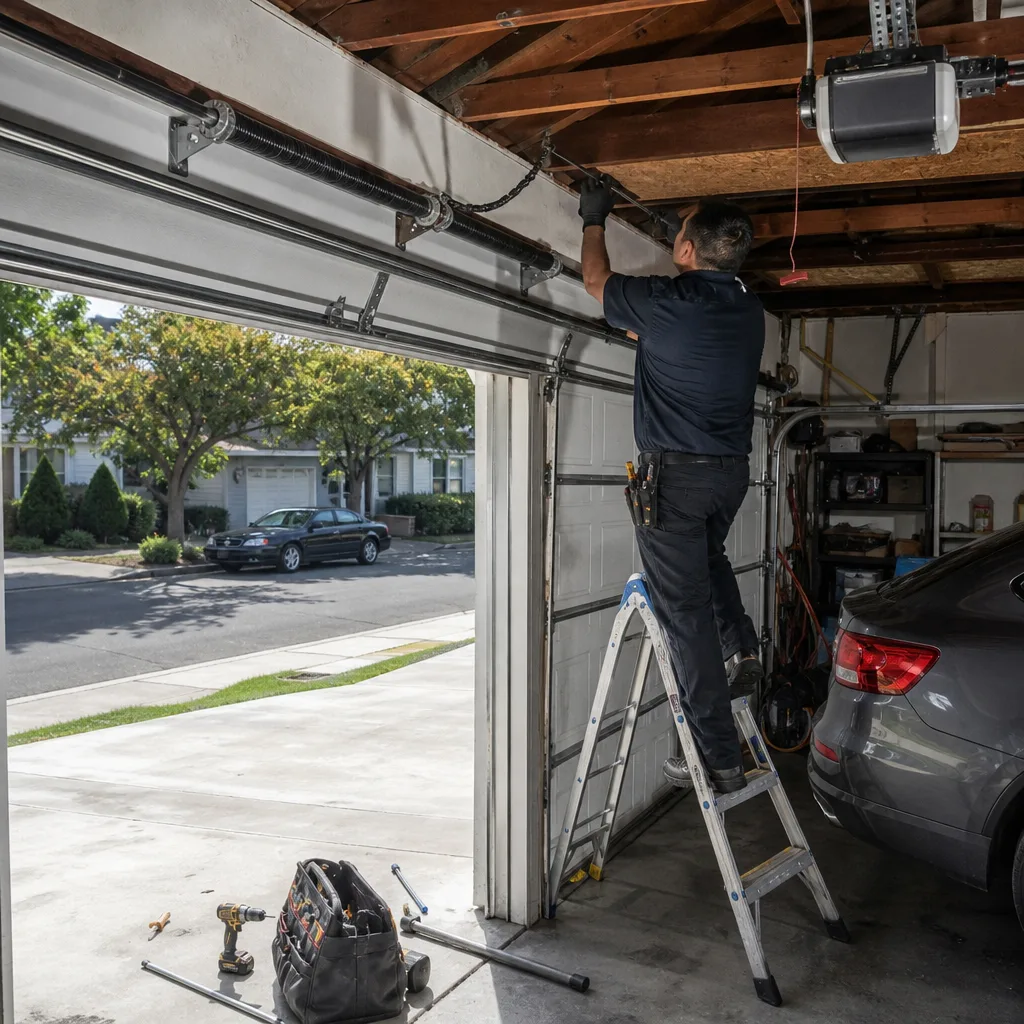
Stand inside your garage with the door closed. Scan left to right across the entire system. Look for:
- Broken or separated cables - the braided steel lift cables that run vertically along each side of the door. A single frayed strand is the beginning of failure.
- Rust on bottom brackets or hinges - orange-brown discoloration where steel meets the door section. In Fremont, this accelerates where morning fog lingers in the Niles and Warm Springs areas.
- Bent or misaligned track - the vertical and horizontal metal channels that guide the rollers. A gap between roller and track means the door is fighting itself every cycle.
- Loose or missing bolts - particularly at the spring anchor bracket mounted to the header above the door.
The Photo-Eye Test
Your garage door has two photo-eyes, small black boxes mounted 4-6 inches above the floor on either side of the door track. They transmit an invisible beam across the door opening. If that beam breaks while the door is closing, the door should reverse immediately.
- Close the door using the wall button.
- As it descends, wave a broom handle through the beam path.
- The door must reverse within 2 seconds. If it doesn’t, the eyes are misaligned, dirty, or failed.
In Fremont’s older neighborhoods like Centerville and Niles, we’ve seen photo-eyes knocked out of alignment by ground settlement shifting the track mounts. The concrete slab tilts; the track follows; the eyes no longer point at each other. This is a $120-$180 adjustment, not a parts replacement, but only if you catch it before the door damages itself against the obstruction it no longer detects.
The Manual Release Check
Pull the red emergency release cord hanging from the trolley carriage. The door should move freely by hand. If it feels heavy or binds in the track, the spring system is losing tension or the track is out of plumb. Re-engage the trolley by pulling the cord toward the motor unit until it clicks.
Safety note: Never pull the release cord while the door is in motion, and never attempt to adjust spring tension yourself. Torsion springs store enough energy to cause serious injury or death. If the door feels heavy after disengaging the opener, that’s a spring problem. Call a professional.
Seasonal Maintenance: Lubrication, Tightening, and Alignment
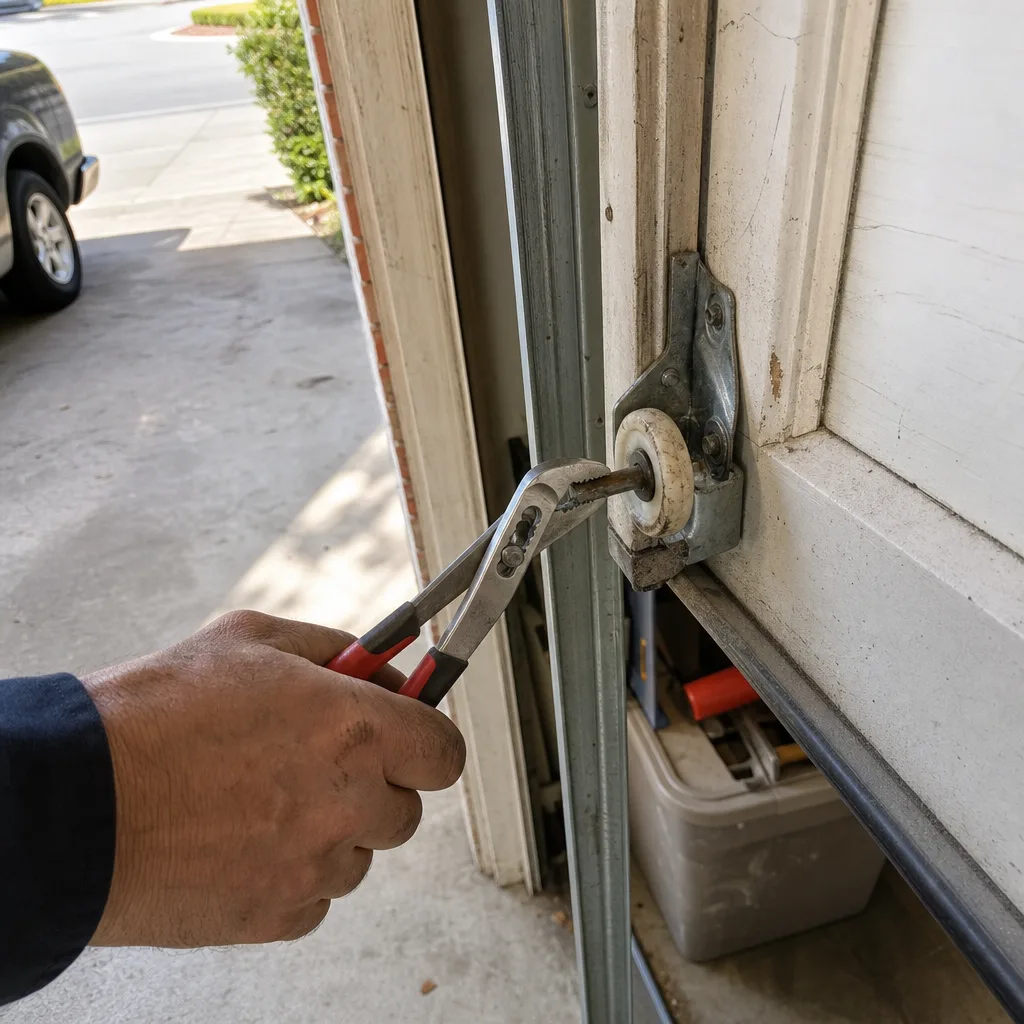
Four times per year, spend 45 minutes on deeper maintenance. March, June, September, and December work well in Fremont’s climate. You’ll need lithium-based grease (white, in a tube or spray can), a socket set, and a clean rag.
What to Lubricate - and What to Leave Alone
| Component | Lubricant | Method | Why the Distinction Matters |
|---|---|---|---|
| Steel rollers (with ball bearings) | Lithium grease | Light coat on the roller shaft where it meets the hinge | Reduces friction without attracting dust |
| Hinges between door sections | Lithium grease | Pin at each hinge pivot point | Prevents squeaking and metal-on-metal wear |
| Torsion spring | None | Do not lubricate | WD-40 and similar penetrate the wire surface, trapping grit that accelerates fatigue cracking |
| Chain or screw drive | Manufacturer-specified lubricant | Light coat per opener manual | Wrong lubricant gums the drive; Genie screw drives specifically call for their own compound |
| Track interior | None | Wipe clean only | Lubricant in the track collects debris and causes roller slippage |
The torsion spring warning bears repeating. We’ve documented dozens of premature spring failures in Fremont where the homeowner applied a “maintenance spray” to “keep it from rusting.” The spring wire develops micro-cracks from flexing 1,500+ times per year. Any film that holds abrasive particles against that surface becomes a cutting tool. A clean, dry spring lasts longer than a “protected” one.
Tightening Hardware
Vibration loosens hardware over hundreds of cycles. Check and snug (don’t over-torque) these points:
- Lag screws in the spring anchor bracket - the bracket mounted to the header above the door. These carry the full spring tension.
- Track mounting brackets - where vertical track attaches to the wall jamb.
- Opener mounting bolts - the angle iron or strut that holds the motor unit to the ceiling.
- Door section hinges - #14 sheet metal screws can work loose.
Use a socket or wrench, not a screwdriver, for lag screws and track bolts. If a bolt spins freely without tightening, the hole is stripped. That’s a $45-$85 repair to re-anchor, not a DIY fix.
Track Alignment Check
With the door closed, visually inspect the vertical track sections. They must be perfectly plumb. Use a level if you have one. The gap between track and door edge should be consistent from bottom to top. A widening gap at the top usually means the upper track bracket has pulled away from the wall, common in older Fremont homes with wood framing that has dried and shifted.
Fremont-Specific Concerns: Climate, Soil, and Salt Air
Fremont’s location at the eastern end of the San Francisco Bay creates conditions that don’t appear in generic maintenance guides. Your garage door system faces specific stresses here that a Sacramento or San Jose homeowner doesn’t encounter in the same way.
Salt Air Corrosion
The Bay’s marine layer pushes inland through the Niles Canyon and along the flat corridor toward Warm Springs and Mission San Jose. Salt in that fog settles on exposed steel. Bottom brackets - the stamped steel fittings at the lower corners of the door where lift cables attach - are particularly vulnerable. They’re close to the ground, they collect condensation, and they’re often the thinnest-gauge steel in the system.
Inspect bottom brackets monthly for orange rust bloom. If you see it, wire-brush the surface, apply a rust converter, and touch up with zinc-rich primer. Replacement bottom brackets run $85-$140 installed. If the rust progresses to pitting, the bracket can fail under load, and that failure drops the door corner suddenly.
Clay Soil and Foundation Movement
Fremont sits on a mix of Bay mud, alluvial deposits, and the clay-heavy soils of the East Bay hills. Clay expands when wet and contracts when dry. The seasonal wet-dry cycle shifts garage slabs, particularly in the hillside neighborhoods above Mission Boulevard and along the Palomares ridge.
What this means for your door: the concrete slab tilts. The vertical track is bolted to the jamb, which is anchored to the slab. When the slab moves, the track goes out of plumb. The door binds. The opener strains. The safety systems may fail to test properly because the door isn’t moving through its designed geometry.
Watch for these signs:
- The door rubs at one corner during the first or last 12 inches of travel
- The weather seal at the bottom gaps on one side
- The opener light blinks and the door reverses for no apparent obstruction
Track realignment in Fremont runs $140-$220. If the slab has settled significantly, a concrete leveling contractor may be needed first. We’ve worked with several in Fremont and can recommend based on your neighborhood.
Temperature Swings and Opener Electronics
Fremont sees 30-degree daily temperature swings common in summer - 55°F at dawn, 85°F by afternoon. Garage attics above uninsulated garages run hotter. The logic board in your opener, the computer that controls motor speed and safety inputs, lives in that heat.
LiftMaster and Chamberlain openers have thermal protection that shuts the motor at 150°F internal temperature. Genie units use a similar cutoff. If your opener works in the morning but stops mid-cycle on hot afternoons, the board or motor is overheating. This isn’t a lubrication problem. It’s a ventilation or component-aging problem. Logic board replacement runs $280-$420 depending on opener model and features.
Component-by-Component Inspection Guide
This section gives you the pass/fail criteria we use when documenting a system for a Fremont customer, with more guides & resources available on our blog. Each item includes what to look for, what failure looks like, and the typical repair cost if you defer action.
Torsion Spring System
What it is: The large coil spring above the door that stores lifting energy. Most residential doors use one or two torsion springs.
Inspection method: Visual only. Do not touch.
Pass: Clean, dry wire with no visible gap between coils when the door is closed. The spring should appear as a solid cylinder, not show daylight through the coils.
Fail: Any visible gap in the coil (a broken spring), rust streaks running down from the spring, or a “stretched” appearance where the coils no longer sit tightly together. A squeaking sound during door operation means the spring is binding on the shaft and needs professional attention.
Cost of deferral: Broken torsion spring replacement in Fremont: $220-$380 for a standard 2-car door. If the broken spring causes the door to crash and bend a section, add $180-$340 per damaged panel. If the opener tries to lift a door with a broken spring and strips the drive gear, add $140-$220.
Safety: Torsion springs are under extreme tension. Never attempt to wind, unwind, or remove a torsion spring. The winding cone can explode with lethal force if handled improperly. This is not a DIY repair.
Lift Cables
What they are: Braided steel cables, 1/8-inch diameter, that transfer spring force to the bottom corners of the door.
Inspection method: Trace each cable from the bottom bracket to the drum at the end of the spring shaft. Look for fraying, kinking, or broken strands. Run a cloth along the cable; snags indicate surface damage.
Pass: Smooth, unbroken braid with no visible rust.
Fail: Any fraying, any broken strand, any kink that has set into the cable. A cable with a “birdcage” appearance at the bottom bracket - where strands have separated - is hours or days from failure.
Cost of deferral: Cable replacement: $140-$220. If the cable breaks with the door open, the door drops unevenly and often bends track or door sections: $340-$650 total.
Rollers
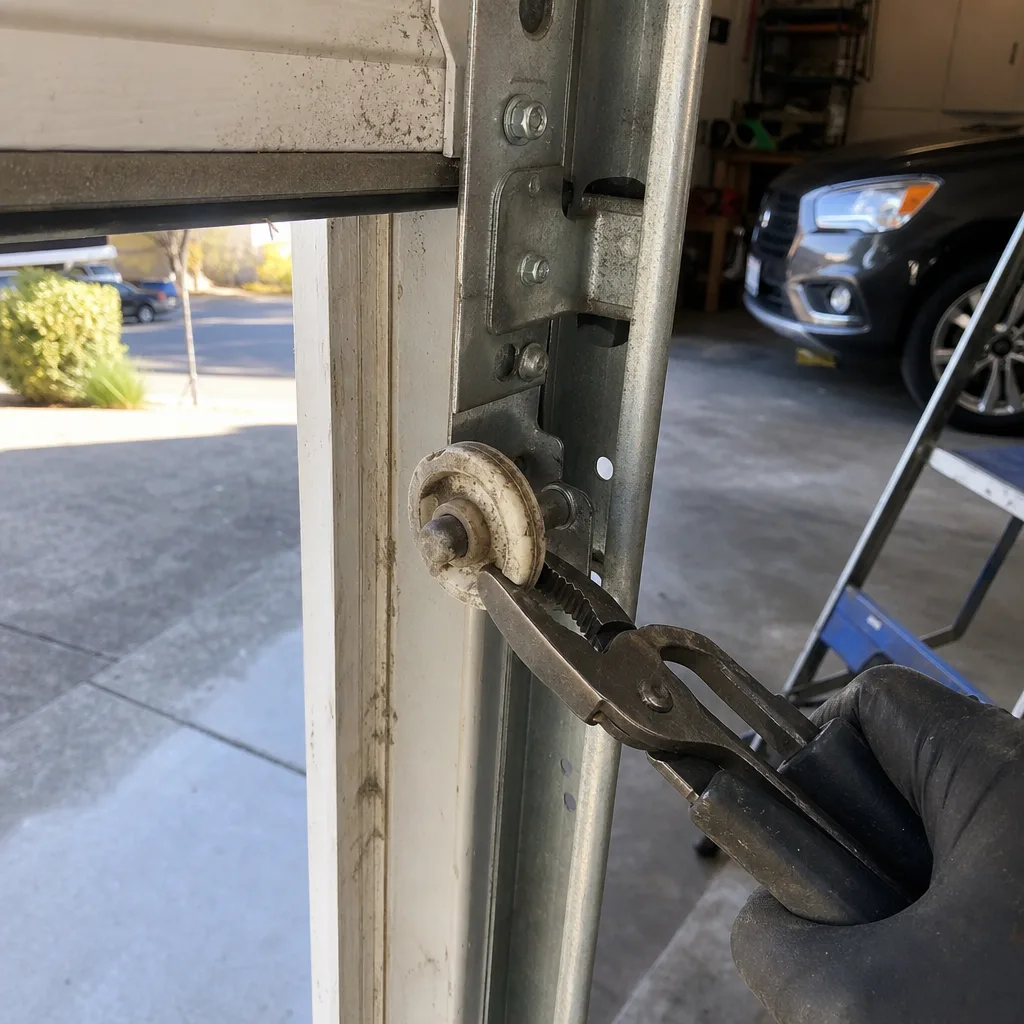
What they are: The wheels that ride inside the track, typically 10-13 per door. Two types: steel with ball bearings, or nylon without bearings.
Inspection method: Watch the door operate. Rollers should roll, not slide or chatter. With the door closed, grasp a roller stem and check for play perpendicular to the track.
Pass: Smooth rolling, no wobble, no grinding noise.
Fail: Flat spots on steel rollers (they’ve been sliding), cracked or chipped nylon, excessive wobble in the stem, or a roller that has jumped the track. A door that sounds like a train on rough track usually has failing rollers.
Cost of deferral: Roller replacement: $12-$18 each for standard steel, $18-$28 each for sealed bearing nylon. Full set for a 16-foot door: $180-$340. If a failed roller jumps track and bends the track section, add $85-$140.
Track System
What it is: The vertical and horizontal steel channels that guide the door.
Inspection method: Visual and with a level. Check for dents, rust-through, and alignment.
Pass: Smooth interior surface, plumb verticals, level horizontals, consistent door-to-track gap.
Fail: Dents that contact the roller, rust holes, widening gap at top or bottom, or track that has pulled away from the wall.
Cost of deferral: Single track section replacement: $140-$220. Full track replacement: $340-$520. If misalignment causes door section damage, add $180-$340 per panel.
Weather Seal
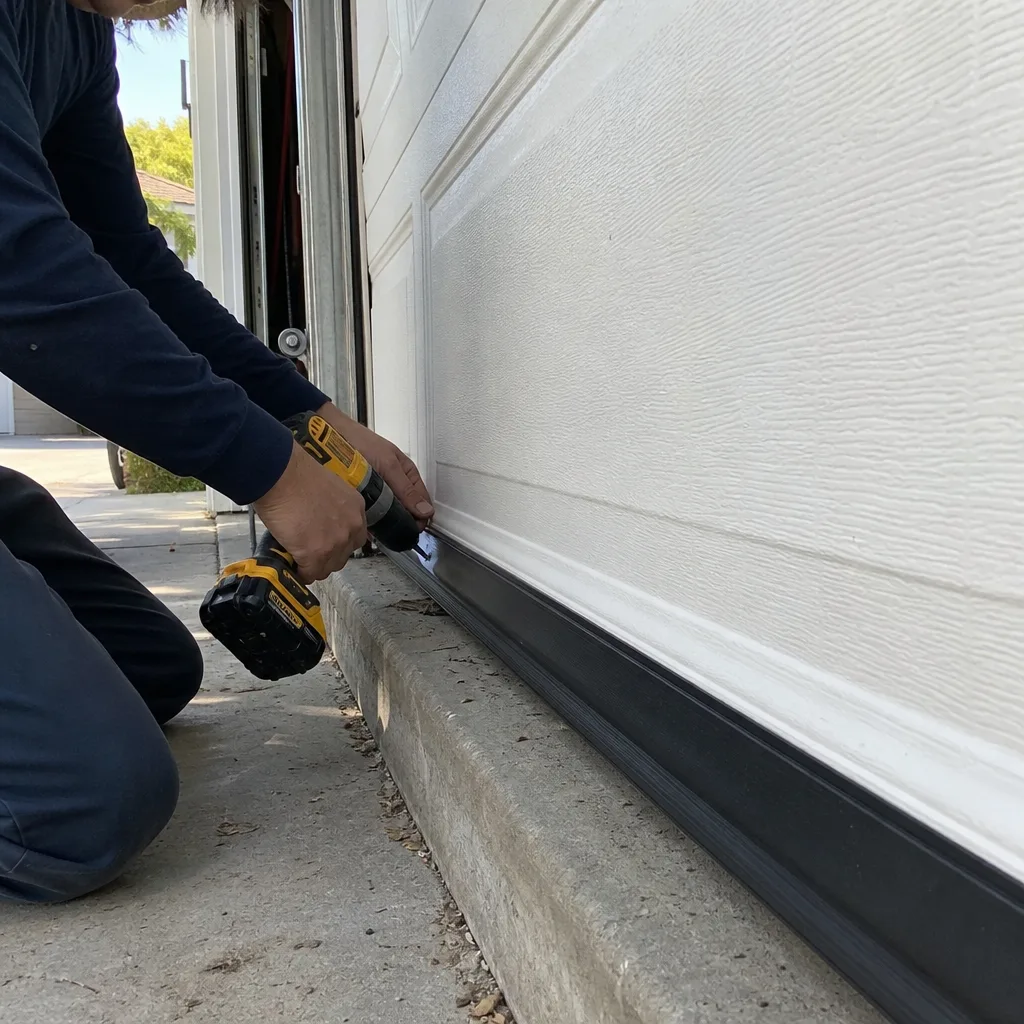
What it is: The rubber or vinyl strip across the bottom of the door.
Inspection method: Close the door and check for daylight underneath. In daylight, look from inside with the door closed.
Pass: Continuous contact with the floor, no cracks or hardening, flexible when pressed.
Fail: Gaps that admit light, water, or rodents; rubber that has hardened and no longer compresses; tears or missing sections.
Cost of deferral: Bottom seal replacement: $85-$140. The real cost is what gets in: water damage to stored items, rodent entry, or conditioned air loss. In Fremont’s variable climate, a failed seal costs measurable energy dollars.
Opener System
What it is: The motorized unit that automates door movement, including the motor, drive mechanism, safety systems, and remote controls.
Inspection method: Operational test and visual.
Pass: Smooth, quiet operation; immediate response to commands; safety reverse functions properly; remote range normal; wall button LED steady (not blinking).
Fail: Grinding or straining motor; intermittent response; reduced remote range; blinking wall button LED (indicates fault code); door that reverses for no visible obstruction; opener that runs but door doesn’t move (stripped drive gear or broken trolley carriage).
Cost of deferral: Drive gear replacement: $180-$280. Logic board: $280-$420. Full opener replacement for a 3/4 HP belt-drive unit: $520-$780 installed. Wayne Dalton and older Genie chain-drive units have specific parts availability; some older models require full replacement when the drive system fails.
How to Document Your Inspection (Your Personal Paper Trail)
Before you call any contractor - including Servo Garage Doors Fremont home - you should have a dated record of what you’ve observed. This protects you from upsells, gives the technician accurate information before arrival, and creates a baseline for tracking system degradation over time.
The Photo Record Method
We built our entire documentation system on this principle. Clause 4 of The Haven Standard requires our technicians to photograph the failed component before quoting replacement. You can apply the same discipline to your own maintenance.
- Date every photo. Use your phone’s timestamp or a photo app that embeds date. Create a folder: “Garage Door [Year].”
- Take the same shots every inspection. Wide shot of the full door closed. Close-up of each spring. Close-up of each bottom bracket. Close-up of the opener unit showing model label. Photo of the track alignment from the side.
- Include a reference object for scale. A coin, a pen, or your hand next to any damage or wear feature.
- Photo any test results. The door reversed when I blocked the photo-eye. The manual release allowed smooth hand operation. Note these in the image filename or a companion text file.
- Store in cloud backup. Google Photos, iCloud, or similar. If you need a second opinion or warranty claim, the dated record is evidence.
What to Record in Writing
A simple text note with each photo set:
- Date and approximate outdoor temperature
- Number of door cycles per day (estimate: 2-4 for most households, 6-8 if you have teenagers or home-based business)
- Any unusual sounds, smells, or behaviors since last inspection
- Brand and model of opener, if known
- Age of door and opener, if known
When you call for service, read this note to the dispatcher. A technician who knows what to bring arrives prepared, which means faster repair and no return trip for parts.
What Skipping Maintenance Actually Costs in Fremont
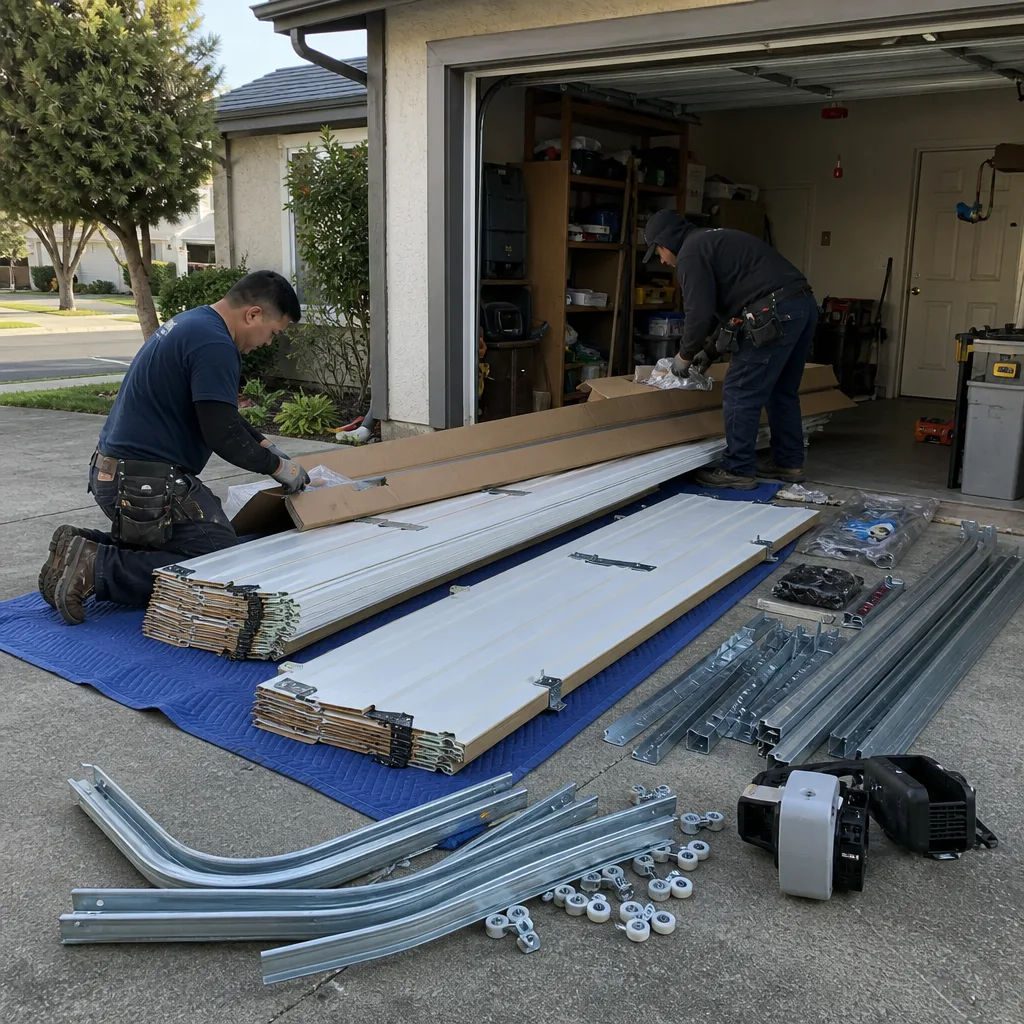
These are the price ranges we quote in writing before any work begins, based on 18,000+ garage doors made right since 2015. Every Fremont job gets a flat, written price and written scope - Clause 1 of The Haven Standard. These numbers let you budget before you call.
| Maintenance Item Skipped | Typical Failure | Repair Cost Range (Fremont) |
|---|---|---|
| Monthly photo-eye check | Misalignment undetected; door closes on obstruction | $120-$180 adjustment; potential liability if vehicle or person damaged |
| Seasonal roller lubrication | Seized roller jumps track; door section bends | $180-$340 roller replacement; $180-$340 per bent section |
| Spring inspection (visual only) | Broken spring; door crashes; opener drive damage | $220-$380 spring; $140-$220 drive gear; $180-$340 section damage |
| Cable inspection | Broken cable; uneven door drop; track damage | $140-$220 cable; $140-$220 track; $180-$340 section |
| Track alignment check | Binding wears opener; premature motor failure | $140-$220 track realignment; $520-$780 opener replacement |
| Weather seal replacement | Water intrusion; rodent entry; energy loss | $85-$140 seal; variable damage costs |
| Opener safety reverse test | Failed auto-reverse; injury or property damage | Liability exposure; $280-$420 safety system repair |
The pattern is consistent: a $120 adjustment deferred becomes a $600 replacement. In Fremont’s market, where the median home value supports investment in maintenance, the economics favor prevention. A $45 tube of lithium grease and 45 minutes quarterly replaces $400 in preventable repairs.
We offer a Garage Door Repair in Fremont service that includes a full system inspection with documented photo record, but the monthly and seasonal checks in this guide are yours to perform. Knowing what you’re looking at is the first defense against being sold work you don’t need.
When to Schedule Professional Service
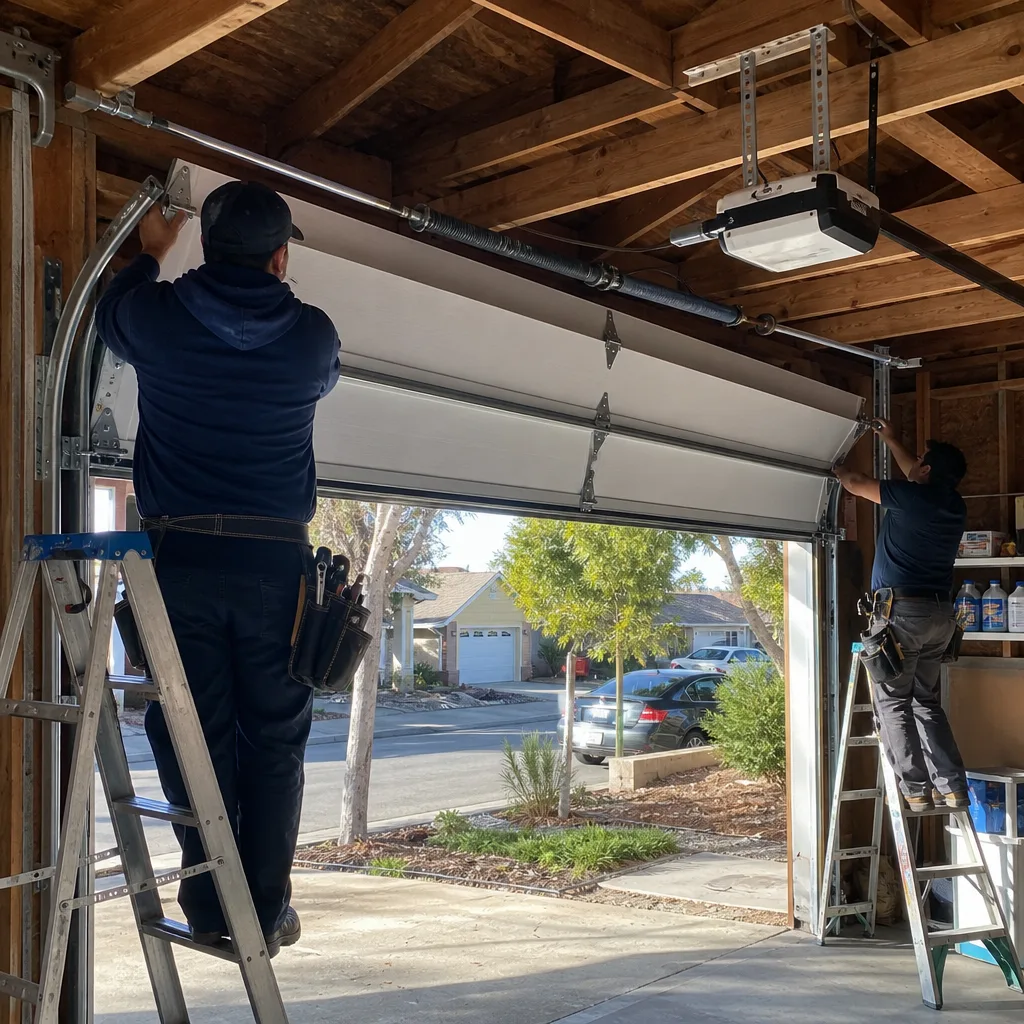
Even diligent DIY maintenance has limits. These are the tasks that require training, tools, and the safety protocols we follow on every Garage Door Installation in Fremont and service call.
Annual Professional Inspection
Schedule once yearly, ideally in September before the rainy season. A qualified technician will:
- Measure spring tension with a winding bar and calculate remaining cycle life
- Test force settings on the opener and adjust to door weight
- Inspect cable drums and bearings invisible to casual observation
- Check opener force and limit switch calibration
- Inspect the header and jamb framing for structural integrity
- Provide a written condition report with photo documentation
Annual inspection cost in Fremont: $85-$140. Many companies, including ours, apply this fee to subsequent repair work if needed.
Immediate Service Triggers
Stop using the door and call for service if you observe any of the following:
- A broken spring (visible gap in the coil)
- A broken or frayed lift cable
- A door that won’t stay open at the halfway position
- An opener that hums but doesn’t move the door
- A door that has come off the track entirely
- Any grinding, popping, or snapping sound during operation
Continuing to operate a door with any of these conditions risks catastrophic failure and personal injury. The Garage Door Opener Repair & Installation in Fremont team at Servo answers live 24/7, including holidays, and dispatches with a named technician and on-the-way text.
Common Mistakes to Avoid
- Using WD-40 on springs or hinges. WD-40 is a water displacer and light penetrating oil, not a lubricant. On springs, it traps grit and accelerates fatigue. On hinges, it dries to a sticky residue that collects dust. Use lithium grease only.
- Lubricating the track interior. The track guides the roller; it does not reduce friction. Lubricant in the track causes rollers to slip, especially nylon rollers, which can cause the door to bind or jump track.
- Ignoring the photo-eye blinking pattern. A steadily blinking opener wall button or photo-eye LED indicates a specific fault code. Two blinks versus four blinks mean different problems. Check your opener manual or call for interpretation rather than masking the symptom.
- Adjusting opener force settings without testing door balance first. If the door is heavy due to a failing spring, increasing opener force compensates temporarily - until the opener fails or the door crushes an obstruction the safety system can no longer detect.
- DIY spring replacement after watching online videos. Torsion spring systems require specific winding bars, knowledge of IPPT (inch-pounds per turn) calculation, and physical control of stored energy. We’ve documented injuries in Fremont from improvised tools and incorrect spring specification.
- Deferring maintenance on a Clopay or Amarr door with pinch-resistant hinges. These hinges have internal springs that wear. When they fail, the hinge separates and the door section edge becomes a pinch point. The safety feature becomes a hazard.
- Not checking Wayne Dalton TorqueMaster systems for specific wear. These enclosed spring systems require specialized knowledge. The spring is inside a tube; visual inspection is limited. If your Fremont home has this system, professional inspection is essential - the spring failure is silent until catastrophic.
When to Call a Professional
Call a technician when your inspection reveals any fail condition in this guide, when you hear sounds you can’t identify, or when the door behaves differently than it has for years. Trust the change, not your hope that it will resolve itself.
Servo Garage Doors Fremont offers free estimates in Fremont - call (669) 333-7846. Every estimate includes a documented photo record of what we find, a flat written price before any work starts, and the 365-Day Done Right Promise backed by The Haven Standard, not a handshake. If you have a written estimate from another company, we’ll provide a free second opinion - bring the paperwork, no coupon required. Our technicians are background-checked, uniformed, and carry our license number on every visit. Calls are answered by a live person 24/7, including emergency garage door calls, with a named technician and an on-the-way text.
Frequently Asked Questions
DIY maintenance costs $15-$30 annually for lithium grease and basic supplies. Professional annual inspection runs $85-$140 in Fremont. If repairs are needed, typical ranges are: roller replacement $180-$340, spring replacement $220-$380, opener repair $180-$420, and track realignment $140-$220. Call (669) 333-7846 for a free estimate with written upfront pricing.
Lubricate hinges and steel rollers every three months with lithium-based grease. Do not lubricate torsion springs, track interiors, or nylon rollers without bearings. In Fremont’s coastal-influenced climate, the marine layer increases corrosion risk on exposed steel, making consistent seasonal lubrication more important than in inland climates.
First, check the photo-eyes for dirt, misalignment, or obstruction. Clean the lenses with a soft cloth and verify the LED indicators on both units are steady (not blinking). If the eyes are aligned and the door still reverses, the close-limit switch on the opener may need adjustment or the door may be binding in the track. If these checks don’t resolve it, call for service - forcing the opener damages the drive system. Call (669) 333-7846 for a free estimate.
No. Torsion springs store lethal energy and require specialized winding bars, spring calculation knowledge, and physical control techniques. Improper handling causes serious injury or death. In our experience serving Fremont since 2015, every DIY spring injury we’ve encountered involved improvised tools and incorrect spring specification. This repair requires a trained professional.
Noise after lubrication usually indicates worn components, not dry ones. Grinding suggests failing roller bearings. Popping or snapping indicates a torsion spring binding on the shaft or a failing hinge internal spring. Squealing during opener operation points to a worn drive gear or trolley carriage. Identify the noise type and location, then call for diagnosis - continued operation damages adjacent components.
Standard torsion springs are rated for 10,000 cycles (approximately 7-10 years for typical use). Fremont’s salt air and temperature swings can accelerate corrosion fatigue, particularly in homes near the Bay or in Niles where fog lingers. High-cycle springs (25,000-50,000 cycles) are available and cost-effective for doors used more than 4 cycles daily. A professional can measure remaining cycle life during annual inspection.
The Bottom Line
A maintenance checklist only protects you if it names the part, shows you the failure, and tells you what ignoring it costs. The ten minutes monthly and 45 minutes seasonally outlined here prevent the majority of emergency garage door calls we receive in Fremont. Document what you find with dated photos. Use lithium grease on the right parts, never on springs. Know the difference between a task you can perform and one that requires a technician with training and tools. And when you do call, expect a written price before any work starts, a photo record of what was found, and a warranty backed by documentation rather than a promise - that’s The Haven Standard, and it’s how we’ve operated since 2015.
Written by Marcus Deller, Owner at Servo Garage Doors Fremont, serving Fremont since 2015.