
Last updated September 21, 2026
Full 25-point door and opener safety check with every visit - springs, cables, rollers, tracks, and your LiftMaster or Chamberlain opener included
You get a price before we start. It does not change when the truck arrives.
The Complete Guide to Garage Door in Fremont
A garage door has 14-17 moving parts depending on configuration, and the one that fails first in Fremont’s coastal-adjacent air is almost always the one nobody checks: the bottom weather seal and its galvanized retainer bracket. Most homeowners in Fremont’s Mission San Jose, Warm Springs, and Ardenwood neighborhoods don’t think about their garage door system until the opener grinds at 6:47 a.m. or the spring snaps with a sound like a gunshot. This guide maps every mechanical and electrical part, its average lifespan, and the local conditions that shorten it, so you’re never diagnosing blind-though you may also want to check our DIY vs Professional Garage Door: The Fremont Homeowner’s Decision Guide before starting any work.
Quick Answer
Residential garage door systems in Fremont consist of four subsystems: the door panel assembly, the counterbalance system (springs and cables), the track and roller hardware, and the motorized opener. Under normal Fremont usage patterns, torsion springs last 8-12 years, openers last 10-15 years, and rollers last 5-7 years, though morning condensation and salt-laden Bay air reaching inland can cut these benchmarks by 20-30% on homes west of Interstate 880.
Table of Contents
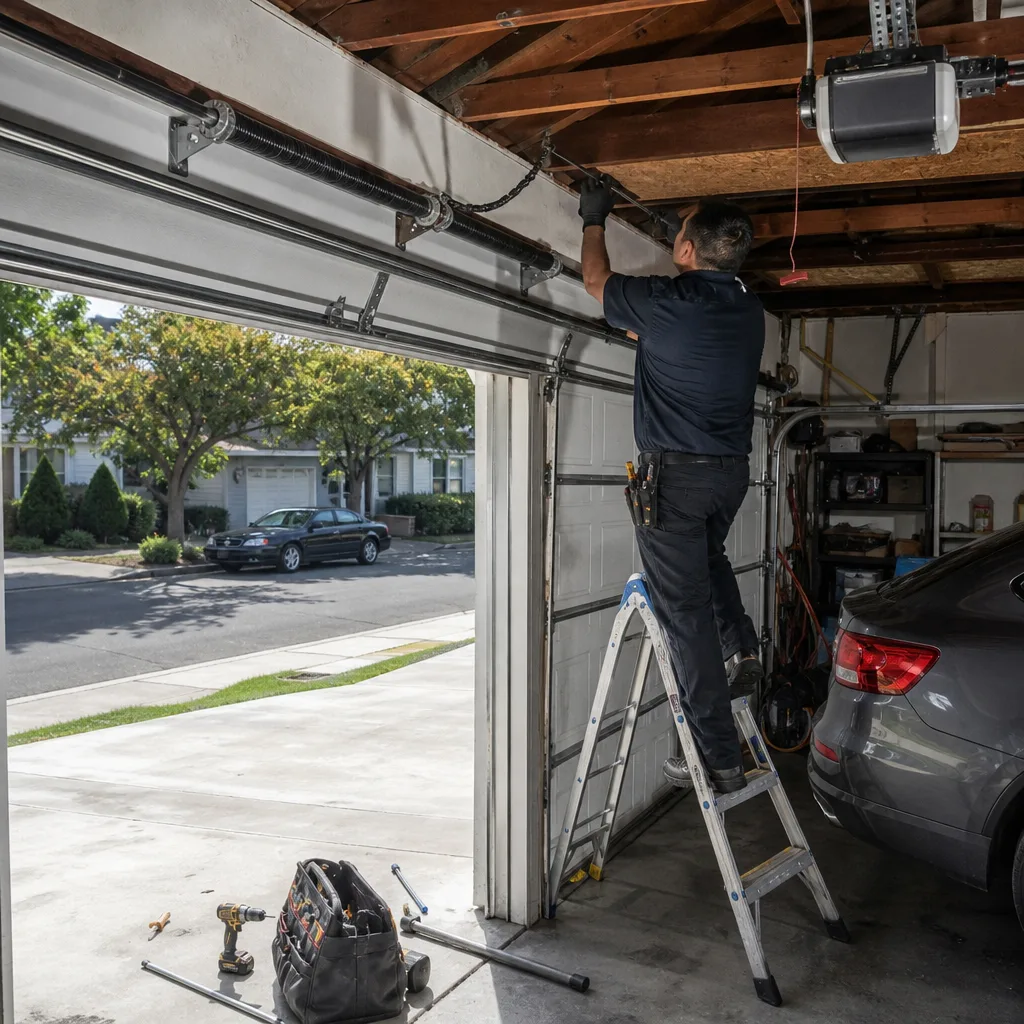
- Anatomy of a Residential Garage Door System
- The Counterbalance System: Springs, Cables, and Drums
- Track, Rollers, and Hinges: The Moving Hardware
- Garage Door Openers: Motors, Drives, and Safety Systems
- How Fremont’s Microclimate Wears Specific Components
- Lifespan Benchmarks Under Fremont Usage Patterns
- Parts Problem vs. Structural Problem: Knowing the Difference
- Why Written-Price-First Documentation Matters
Anatomy of a Residential Garage Door System
Every garage door system, whether it’s a 16-by-7-foot steel panel door in a Centerville townhome or a custom wood overlay in the Niles district, breaks down into four subsystems. Understanding which subsystem produces a symptom saves time and prevents misdiagnosis.
The Door Panel Assembly
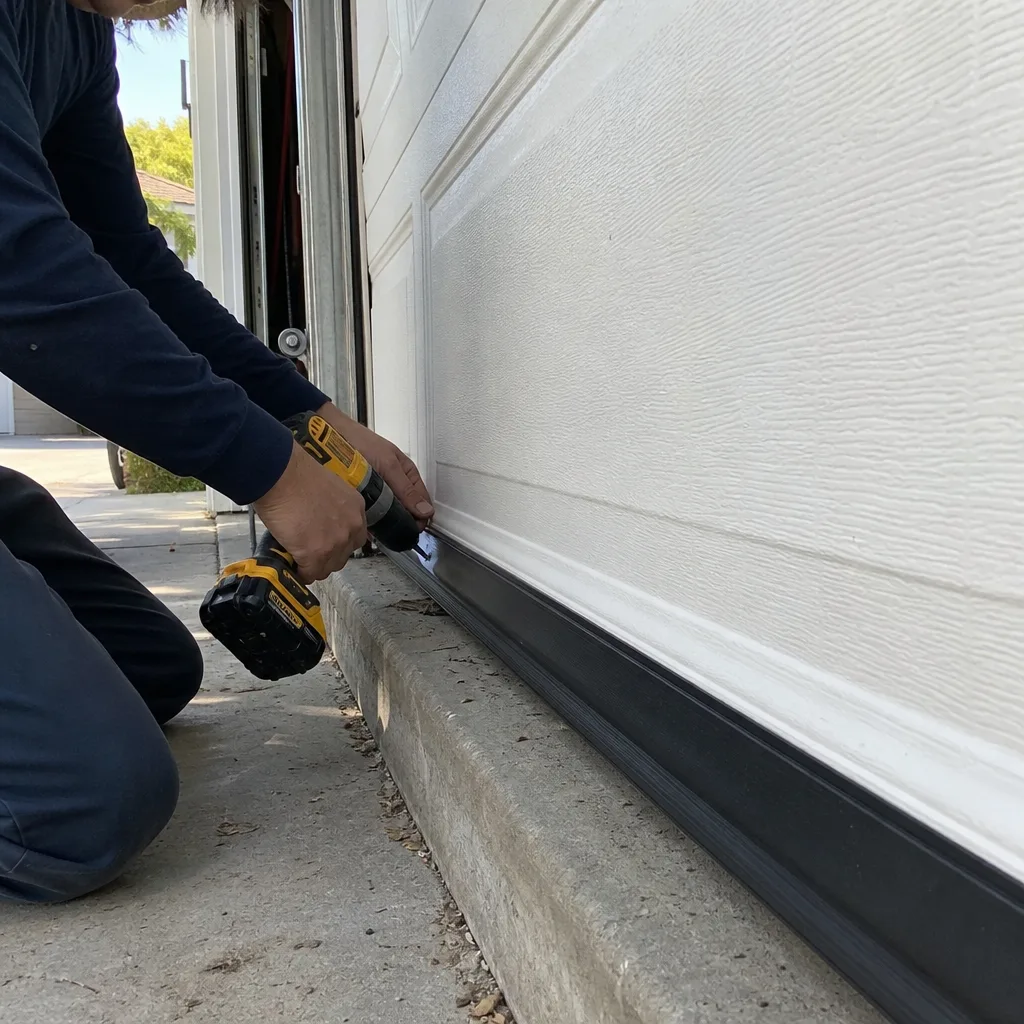
The visible portion consists of hinged sections (typically four or five on residential doors), each with interior struts for reinforcement. The bottom section carries the weather seal in an aluminum or galvanized retainer bracket. This retainer bracket is where Fremont’s climate does its earliest damage: condensation collects overnight, and the galvanized coating on older brackets eventually succumbs to the salt-laden air that penetrates inland through the Golden Gate. We’ve replaced retainer brackets in Fremont’s Baylands-adjacent neighborhoods where the steel showed active corrosion after just six years.
The Counterbalance System
This is the heavy-lifting subsystem. Torsion springs mounted on a steel shaft above the door opening, or extension springs running parallel to the horizontal tracks, store mechanical energy to offset the door’s weight. Cables wrap around drums at each end of the torsion shaft and attach to the bottom fixtures on the lowest door section. When a spring breaks, the door becomes dead weight, typically 150-250 pounds depending on material and size.
The Track and Roller Hardware
Two vertical tracks guide the door from the closed position; two horizontal tracks carry it overhead. Hinges connect door sections and carry rollers (steel, nylon, or sealed-bearing nylon) that ride inside the track channels. The hinge at the bottom of each section is a #1 hinge; the top is a #4 or #5, depending on door height.
The Motorized Opener
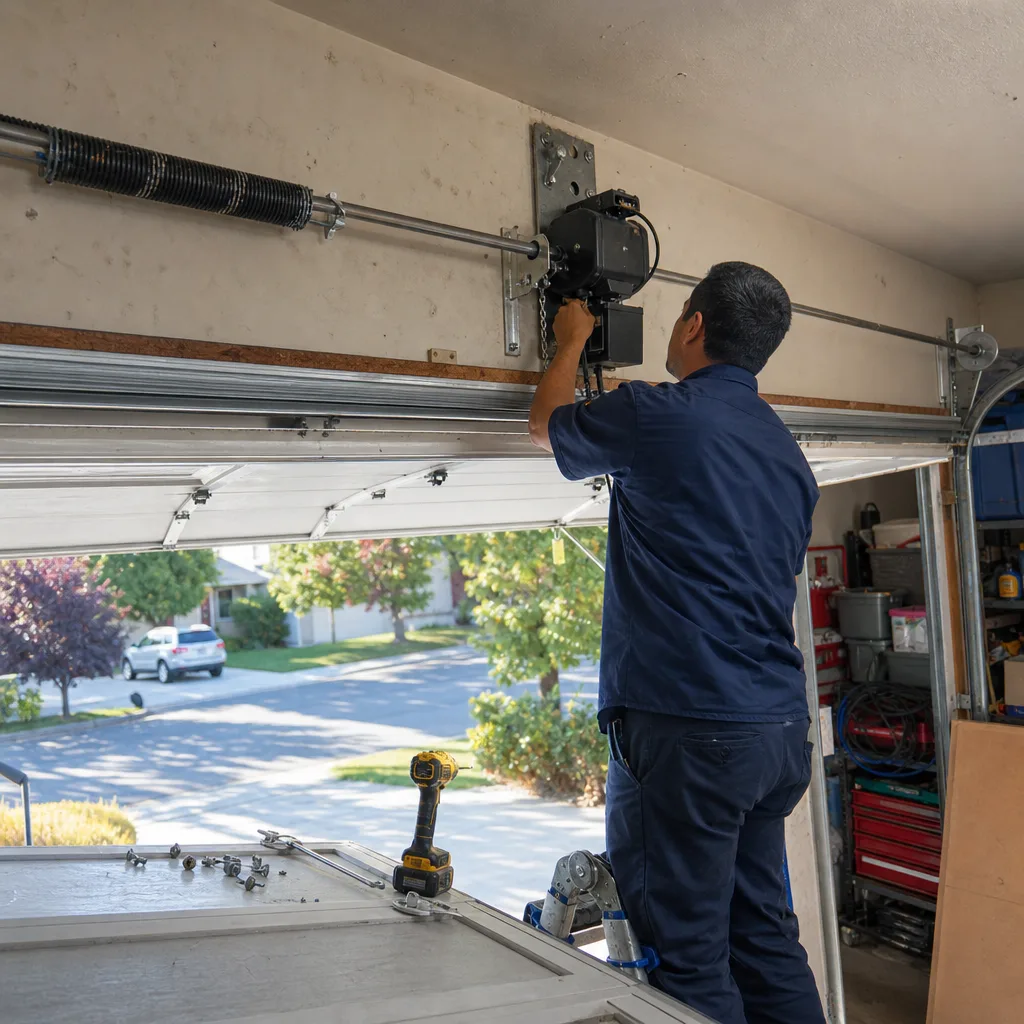
Mounted to the ceiling or wall, the opener drives a trolley carriage along a rail, connecting to the door via an operator arm. The motor unit contains a logic board (the computer), a gear assembly, and a limit switch system that tells the motor when to stop at the fully open and fully closed positions. Safety sensors, mounted 4-6 inches above the floor on either side of the opening, complete the circuit only when aligned.
Garage Door Repair in Fremont covers each of these subsystems in detail, with specific diagnostic approaches for the symptoms each produces.
The Counterbalance System: Springs, Cables, and Drums
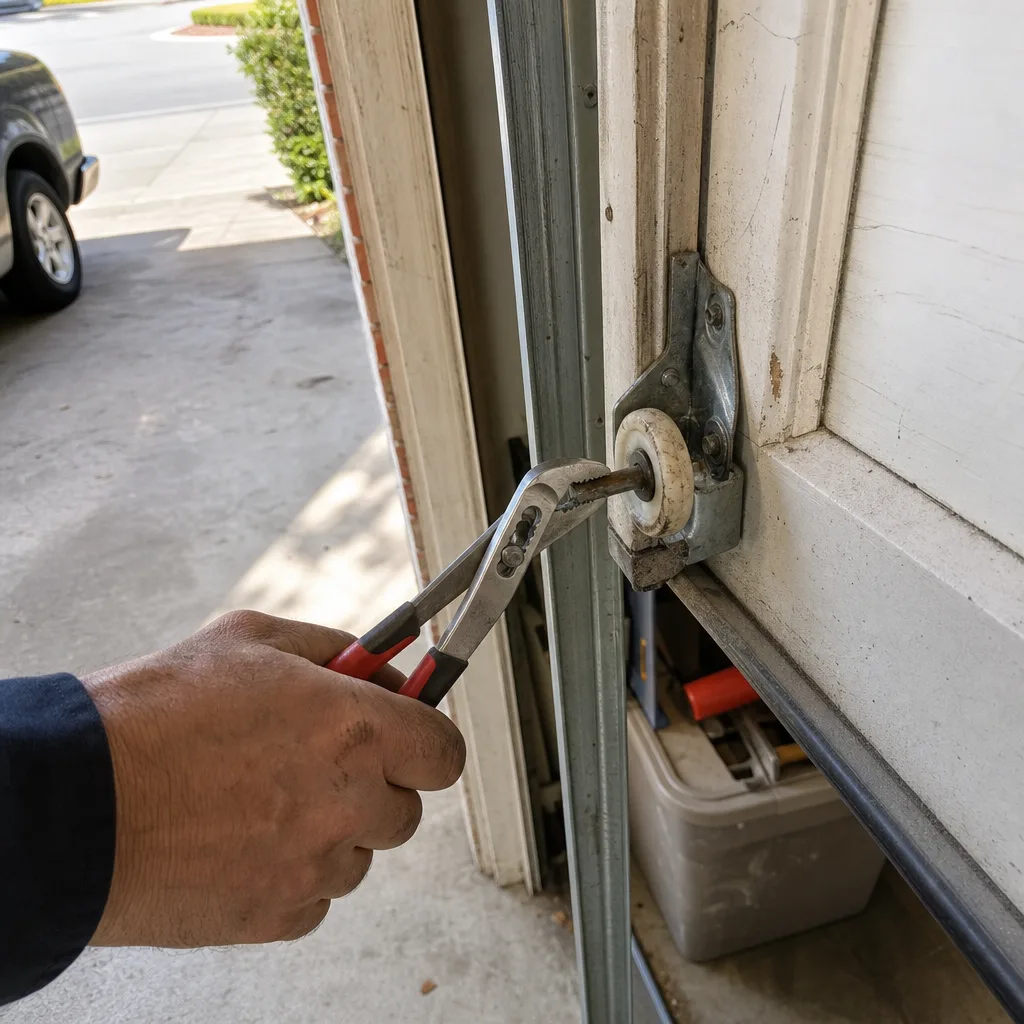
The counterbalance system is where most emergency calls originate, and it’s also where DIY attempts cause the most serious injuries. Torsion springs store massive mechanical energy: a standard 0.25-inch wire diameter spring on a 16-foot door is wound to roughly 10,000 inch-pounds of torque. If a winding bar slips or a cable breaks under tension, the result can be fatal.
Safety caveat: Never attempt to wind, unwind, or replace a torsion spring without proper training and tools. The winding cones on torsion springs are under lethal tension. A trained technician uses solid steel winding bars, not screwdrivers or pliers, and follows a specific unwinding sequence. If your spring has failed, call a professional.
How Torsion Springs Work
Torsion springs are calibrated to the door’s weight using a simple formula: wire diameter, inside diameter, and overall length determine the spring’s torque rating, measured in inch-pounds per turn. A properly specified spring provides roughly 10% of the door’s weight in lifting force per turn, with the total wound turns matching the door’s height in feet plus three-quarters. For a standard 7-foot door, that’s 7.75 turns.
When we inspect a spring in Fremont, we measure three things: the wire diameter with calipers, the inside diameter with a tape measure, and the number of active coils. We also photograph the break pattern. A clean break at the coil body indicates normal fatigue failure. A distorted or rust-pitted break suggests environmental acceleration, which is common in Fremont’s older neighborhoods where garages lack adequate ventilation.
Cables and Drums
Lift cables are 7×19 aircraft-grade galvanized steel, 1/8-inch diameter on most residential doors. They wrap around grooved drums that are keyed to the torsion shaft. The drum’s groove geometry varies by door height: standard-lift drums for 7-foot doors, high-lift drums for garages with extra headroom, and vertical-lift drums for commercial applications.
Cable failure in Fremont usually follows one of two patterns. The first is fraying at the bottom fixture, where the cable passes through a cast iron pulley or sheave; the pulley groove wears, pinching the cable. The second is corrosion at the looped end that attaches to the bottom fixture, accelerated by the same moisture that attacks weather seal retainers. In our experience, cable replacements in Fremont outnumber spring replacements by roughly 30% on homes built before 1990, where original hardware lacks modern corrosion protection.
Extension Spring Systems
Older Fremont homes, particularly in the Glenmoor and Parkmont areas, may still have extension springs running parallel to the horizontal tracks. These stretch and contract to balance the door, with safety cables running through their centers to contain fragments if they break. Extension springs are more exposed to environmental damage than torsion springs and generally have shorter lifespans. We typically recommend converting to a torsion system during replacement, as torsion springs distribute load more evenly and allow finer balance adjustment.
Track, Rollers, and Hinges: The Moving Hardware
The hardware subsystem seems simple until it isn’t. A binding track, a seized roller, or a cracked hinge can mimic opener failure, spring fatigue, or door imbalance. Proper diagnosis requires isolating the door from the opener and testing manually.
Track Specifications and Alignment
Residential tracks are 2-inch or 3-inch galvanized steel, with the vertical track set back from the door jamb by a specific dimension called the track-to-jamb, or “T-to-J.” On a standard installation, this is 1/2 to 3/4 inch. If the track leans or the jamb settles, the rollers bind in the track channel. We’ve seen this frequently in Fremont’s hillside developments, where seasonal soil movement shifts garage framing.
Track alignment is checked with a level and a tape measure: the vertical tracks must be plumb within 1/4 inch over their full height, and the horizontal tracks must slope down toward the opener by approximately 1/4 inch per foot. Misalignment accelerates roller wear and can cause the door to derail.
Roller Types and Lifespan
| Roller Type | Typical Lifespan (Cycles) | Best Application |
|---|---|---|
| Standard steel, unsealed | 5,000-7,000 | Budget installations, rarely recommended |
| Steel with zinc plating | 7,000-10,000 | Moderate-use residential |
| Nylon wheel on steel stem | 10,000-15,000 | Most Fremont homes |
| Sealed-bearing nylon | 15,000-20,000 | High-cycle or quiet-operation needs |
One cycle equals one full open-and-close. For a door used four times daily, that’s roughly 1,460 cycles per year. A standard steel roller in Fremont’s environment may show stem corrosion before it reaches its cycle limit, particularly if the garage faces west and catches afternoon sun followed by evening fog.
Hinges and Center Stiles
Hinges are numbered by position: #1 at the bottom, #2 above it, and so on. The #1 hinge carries the most load and fails most often. Center stiles, the vertical reinforcement pieces on each door section, prevent panel bowing under wind load or opener pull. On wide doors (16 feet or more), a strut across the top section adds rigidity. We’ve found cracked #1 hinges on Fremont doors where the opener’s down-force setting was too aggressive, slamming the door against the floor and transmitting impact through the bottom fixture.
Garage Door Openers: Motors, Drives, and Safety Systems
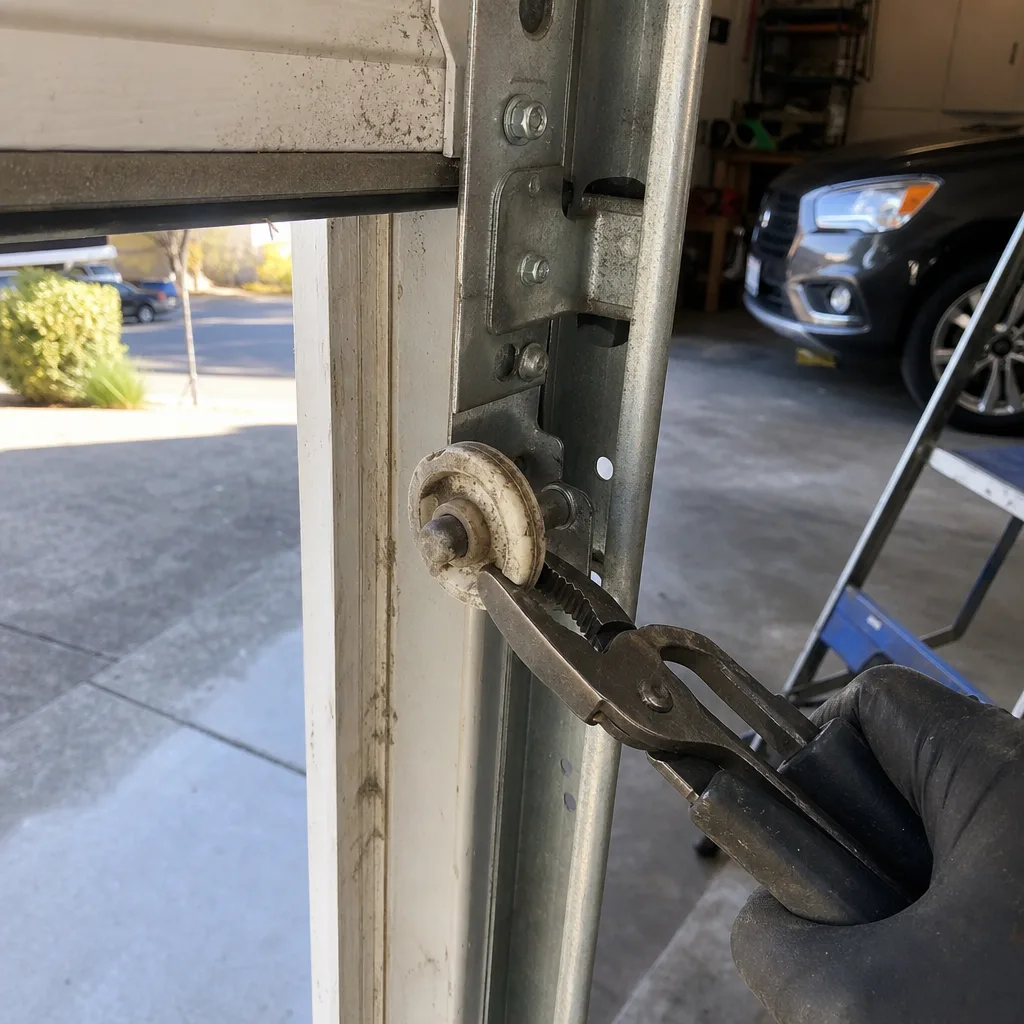
The opener is the electrical subsystem, and it’s where homeowners most often misattribute symptoms. A door that reverses before closing, for instance, could be a force-setting issue, a misaligned safety sensor, a binding track, or a damaged bottom seal creating excess drag.
Drive Types: Chain, Belt, Screw, and Direct
Chain-drive openers use a metal chain on a sprocket, durable but noisy. Belt-drive units replace the chain with a reinforced rubber belt, quieter and increasingly standard for attached garages. Screw-drive openers, less common now, use a threaded steel rod; they require periodic lubrication and struggle in temperature-extreme environments. Direct-drive systems, such as those from Sommer, move the motor itself along the rail, eliminating most wear points.
In Fremont’s market, we install LiftMaster and Chamberlain belt-drive units most frequently for residential applications, with chain-drive reserved for heavy or oversized doors. Genie screw-drive openers appear occasionally in older installations. Raynor-branded openers, manufactured by LiftMaster, are common in homes built by specific Fremont-area developers in the 2000s.
The Logic Board and Limit Switches
The logic board is the opener’s computer, receiving input from the wall button, remote controls, safety sensors, and force-sensing circuits. It sends output to the motor relay and the travel limit system. Modern boards include Wi-Fi modules for smartphone control and battery backup for California compliance.
Limit switches tell the motor when to stop. On chain and belt drives, these are typically mechanical switches triggered by a shuttle on the rail. Misadjusted limits cause the door to stop short or overrun, potentially damaging the opener or the door. Force settings, adjustable via dials or digital menus, determine how much resistance triggers reversal. California building code requires automatic reversal within 2 seconds of contact with an obstruction.
Safety Sensors and Their Failure Modes
Photo-eye sensors emit an invisible infrared beam across the door opening. If the beam breaks during closing, the opener reverses. Common failures in Fremont include:
- Physical misalignment: Bumped by a bicycle, trash bin, or vehicle mirror. The LED indicators show whether each eye sees the other.
- Condensation on lenses: Morning fog in unheated garages coats the lenses, diffusing the beam. Wiping with a dry cloth usually restores function.
- Wiring damage: Rodents in garage ceilings chew low-voltage sensor wiring, particularly in older Fremont homes with mature landscaping and established tree canopies.
- Electrical interference: LED bulbs in the opener housing can emit frequencies that confuse the receiver. We see this with certain off-brand bulb types.
Garage Door Opener Repair & Installation in Fremont covers diagnostic procedures and replacement options for each of these failure modes.
How Fremont’s Microclimate Wears Specific Components
Fremont sits in a unique position: close enough to San Francisco Bay to receive marine air influence, but far enough inland to experience hotter, drier summers than coastal cities. This creates specific corrosion and wear patterns that shorten component lifespans compared to national averages.
Morning Condensation and Its Effects
From October through April, overnight temperature drops in Fremont’s lower elevations, particularly in the Central District and Irvington areas, produce heavy condensation on cold steel surfaces. Garage doors, especially north-facing units, collect moisture on tracks, springs, and hardware. This moisture carries dissolved salts from the marine layer, creating an electrolyte that accelerates galvanic corrosion.
The first components to show damage are:
- Bottom weather seal retainers: Galvanized steel brackets hold the rubber or vinyl seal. When the zinc coating wears, steel rusts, expanding and cracking the seal. Water then enters the door sections, causing internal rust on steel doors or delamination on wood composites.
- Track mounting brackets: The J-brackets or flag brackets that attach vertical track to the door jamb are often standard steel. We’ve replaced brackets in Fremont where the bolt holes had elongated due to corrosion-thinning of the metal.
- Spring anchor bracket: The stationary cone of a torsion spring mounts to a cast iron or steel bracket above the door center. This bracket is rarely painted or coated beyond factory galvanizing, and it sits in the path of rising moist air.
Salt-Laden Air Penetration
While Fremont is not a coastal city, the Bay’s marine layer pushes inland through the Carquinez Strait and across the Delta, reaching the 880 corridor regularly. Homes west of Interstate 880, in areas like Baylands and parts of Warm Springs, experience more salt exposure than those east of the hills. The effect is cumulative: a door hardware system that might last 12 years in a dry inland climate shows significant corrosion in 8-9 years in these Fremont microclimates.
Thermal Cycling
Fremont’s summer temperature swing, from 55°F morning lows to 85°F afternoon highs, causes repeated expansion and contraction of metal components. This thermal cycling fatigues springs slightly faster than in more stable climates. The effect is modest, roughly 5-10% lifespan reduction, but it compounds with corrosion effects.
Soil and Settlement
Fremont’s varied geology, from Bay mud fill to hillside bedrock, means garage foundations settle at different rates. We’ve tracked alignment issues in specific neighborhoods: the hillside developments above Mission Boulevard, where seasonal moisture changes cause more movement; and the older flatland areas near Thornton Avenue, where expansive clay soils swell and shrink. Track misalignment from settlement is a structural issue, not a parts issue, and it requires different correction than roller replacement.
Lifespan Benchmarks Under Fremont Usage Patterns
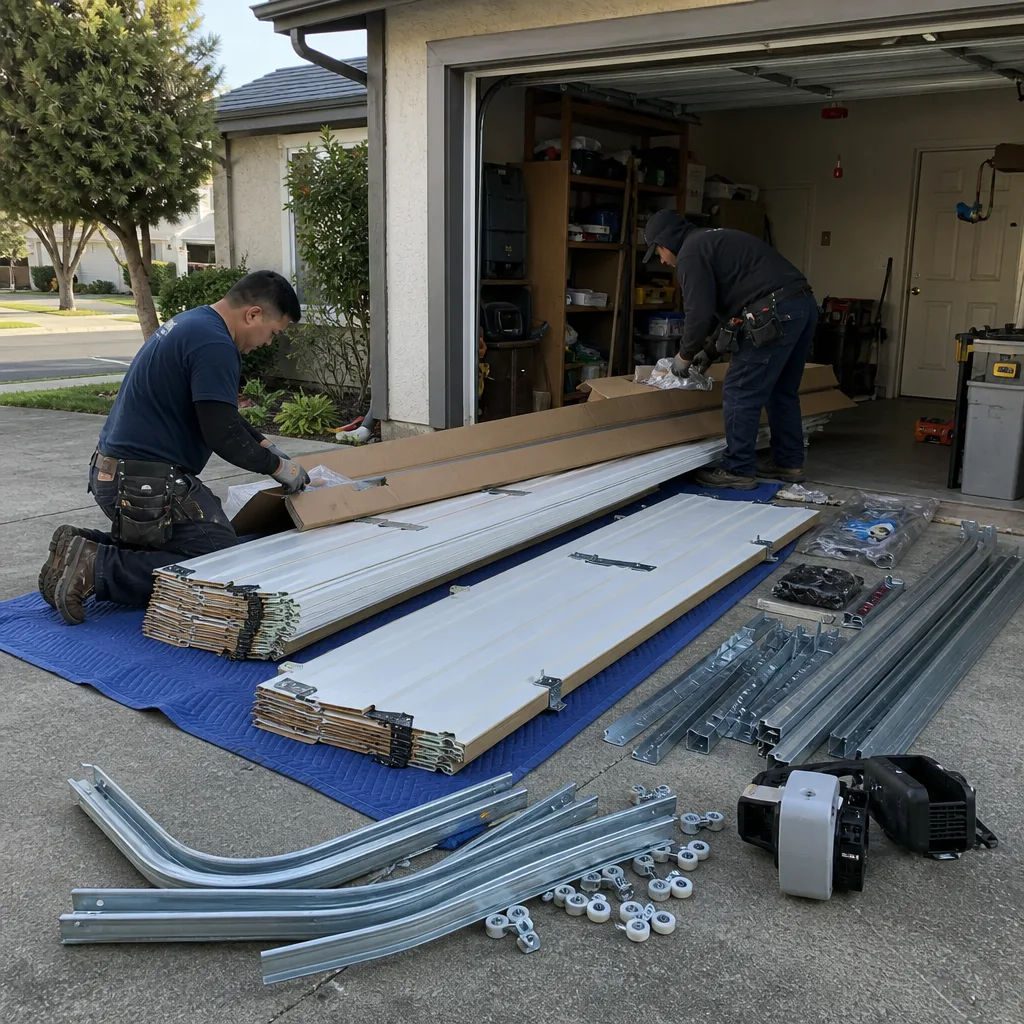
National lifespan averages for garage door components assume moderate climates and typical usage. Fremont’s conditions modify these benchmarks. The table below reflects our field observations across thousands of service calls in the East Bay.
| Component | National Average | Fremont Adjusted | Key Local Factor |
|---|---|---|---|
| Torsion springs | 10,000-15,000 cycles (8-12 years) | 8,000-12,000 cycles (6-10 years) | Corrosion at anchor bracket; thermal fatigue |
| Extension springs | 8,000-10,000 cycles | 6,000-8,000 cycles | Greater exposure to moisture and salt air |
| Lift cables | 10,000-15,000 cycles | 8,000-12,000 cycles | Bottom fixture corrosion; pulley groove wear |
| Nylon rollers | 10,000-15,000 cycles | 8,000-12,000 cycles | Stem corrosion in unsealed types |
| Sealed-bearing rollers | 15,000-20,000 cycles | 12,000-18,000 cycles | Bearing seal degradation from dust and moisture |
| Chain-drive opener | 10-15 years | 10-14 years | Minimal climate impact; electronics age |
| Belt-drive opener | 10-15 years | 10-14 years | Belt UV degradation if garage has windows |
| Weather seal | 3-5 years | 2-4 years | UV exposure; bottom retainer corrosion |
| Safety sensors | 10+ years | 8-12 years | Condensation damage to circuitry |
These benchmarks assume standard residential usage: 3-5 cycles per day. A home with teenagers, multiple drivers, or a workshop garage may double this usage and halve the lifespan. We always ask about cycle frequency when quoting replacement, because a family of four in Fremont’s Weibel neighborhood with two commuters and a student driver may need high-cycle springs rated for 25,000 cycles rather than standard 10,000-cycle units.
Parts Problem vs. Structural Problem: Knowing the Difference
This distinction determines whether you need a parts replacement, an installation correction, or a structural repair, and our more guides & resources can help you understand each scenario. Misdiagnosis wastes money and can create safety hazards.
Parts Problems
Parts problems involve components that wear through normal use and are designed for replacement. Symptoms include:
- A single broken spring with no other symptoms
- Frayed cable with intact spring and aligned track
- Noisy operation resolved by roller replacement
- Opener reversal fixed by sensor realignment or replacement
- Worn weather seal allowing water intrusion
These are straightforward repairs with defined parts and labor. A written quote should itemize the component, its specifications, and the installation labor. At Servo Garage Doors Fremont, we photograph the failed part before quoting, per Clause 4 of The Haven Standard, so the customer sees what we found.
Structural and Installation Problems
Structural problems involve the garage opening, framing, or foundation, or errors in the original door installation. Symptoms include:
- Door rubbing on one side of the frame, with plumb tracks and intact rollers
- Recurring cable derailment despite new cables and drums
- Opener straining or overheating on a properly balanced door
- Panel damage concentrated at one hinge location
- Track mounting bolts pulling out of the jamb repeatedly
These indicate settled or twisted framing, an out-of-square opening, or improper spring calibration for the door weight. In Fremont’s older neighborhoods, we encounter headers that have sagged under roof load, shifting the opening geometry. In newer construction, rushed installation sometimes leaves insufficient backroom for the horizontal track, forcing steep track angles that accelerate wear.
A parts technician who doesn’t recognize structural issues will replace components repeatedly without solving the root cause. We flag structural concerns during our initial inspection and explain whether correction requires carpentry, foundation work, or track reconfiguration. Garage Door Installation in Fremont addresses proper specification and installation standards for new or replacement doors.
The Critical Test: Manual Operation
The essential diagnostic step is disconnecting the opener and operating the door by hand. A properly balanced door should:
- Stay at any position between fully open and fully closed when released
- Rise smoothly from the closed position with one hand using moderate force
- Lower smoothly without accelerating or slamming
- Run quietly in the tracks without binding or lateral play
If the door fails any of these tests, the problem is in the counterbalance system, the track alignment, or the door hardware, not the opener. We perform this test on every service call and document the results in the photo record delivered to the customer.
Why Written-Price-First Documentation Matters
Garage door failures often involve multiple components failing together or in sequence. A broken spring stresses cables; a dragging door overloads the opener; corroded hardware seizes rollers. When several parts need attention simultaneously, homeowners face a trust problem: how do they know which replacements are necessary and which are speculative?
The Problem with Verbal Estimates
Verbal estimates, or “call for a quote” systems, create information asymmetry. The technician knows what they found; the homeowner must take their word. This dynamic invites upselling, particularly on emergency calls when the door is stuck open or the vehicle is trapped inside.
Clause 1 and Clause 4 in Practice
The Haven Standard’s Clause 1 requires a flat, written price and written scope before any work begins. Clause 4 requires photographing the failed component before quoting replacement. Applied together, they produce a specific customer experience:
- Technician arrives, identifies symptoms, performs manual operation test
- Technician photographs failed or worn components with customer’s camera or company tablet
- Technician writes scope: specific parts by specification, labor operations, total price
- Customer reviews scope and price; approves, modifies, or declines
- Work proceeds only after written approval
- Completed work is photographed; photo record delivered to customer
This matters most on multi-component failures. In Fremont’s Cabrillo neighborhood last year, we responded to a call for a broken spring and found corroded cables, a cracked #1 hinge, and an opener force setting that had been maxed out to compensate for the weakening spring. Four components, four separate decisions. Our technician photographed each, wrote four line items with individual prices, and the customer chose to address the spring and cables immediately, schedule the hinge for the following week, and adjust the opener settings after the mechanical repairs were complete. Total invoice matched the approved scope exactly.
Without written documentation, that same call might have produced a single bundled price with no itemization, or a verbal “this needs everything” recommendation with no evidence. The 365-Day Done Right Promise backs the work, but the documentation is what makes the promise enforceable.
Servo Garage Doors Fremont home includes our full terms and The Haven Standard documentation.
Common Mistakes to Avoid
- Ignoring the weather seal: In Fremont, a cracked bottom seal lets moisture into door sections and onto the concrete floor, accelerating hardware corrosion and creating slip hazards. Check the seal quarterly; replacement is inexpensive preventive maintenance.
- Maxing out opener force settings: When a door becomes harder to move, homeowners or inexperienced technicians sometimes crank the opener’s down-force to override the resistance. This masks the underlying problem and risks crushing whatever the door contacts.
- DIY spring replacement: Online tutorials make torsion spring replacement look manageable. The energy stored in a wound spring is equivalent to dropping the door from ceiling height. The injury rate for untrained attempts is significant.
- Replacing the opener when the door is at fault: A binding or unbalanced door will destroy any opener eventually. We see this in Fremont’s 1970s-era homes where original track hardware is worn. The opener fails, gets replaced, and fails again within two years.
- Neglecting sensor alignment after cleaning: It’s easy to bump a photo-eye sensor while sweeping or moving storage. If the door reverses mysteriously, check the sensor LEDs before calling for service. One minute of alignment often solves the problem.
- Assuming all springs are equal: Springs are specified by wire size, inside diameter, and length. A spring that looks similar but is wound for a lighter door will be overstressed and fail prematurely. We match specifications exactly, and we photograph the old spring’s markings before removal.
- Waiting for total failure: A noisy roller or a slow-opening door is communicating wear. Addressing it on your schedule prevents the emergency call at 7 a.m. with a vehicle trapped inside.
When to Call a Professional
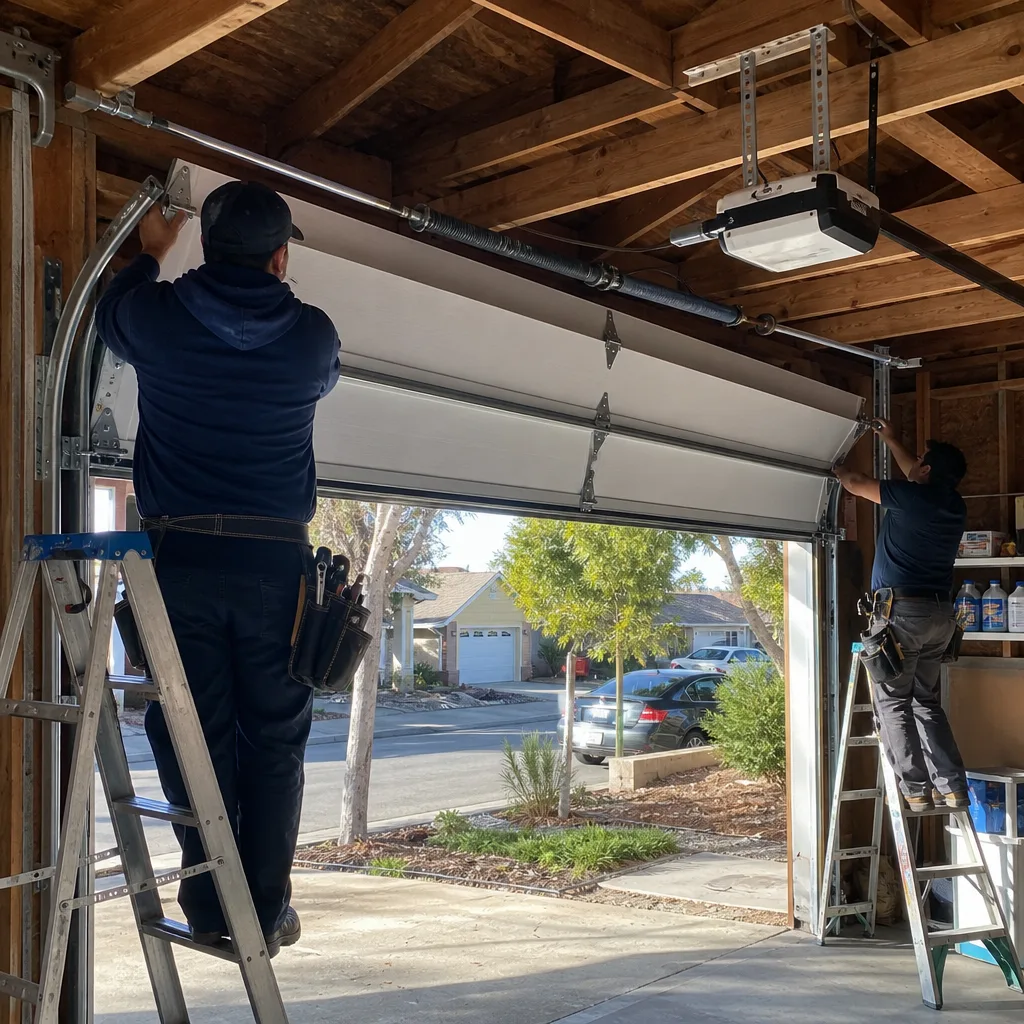
Call a technician when you observe any of the following: a broken spring or cable (the door is dead weight and dangerous to move), a door that won’t stay open or closed, grinding or popping noises from the opener or hardware, repeated sensor failures after basic troubleshooting, or visible track damage or separation from the wall. Any of these can escalate from inconvenience to safety hazard.
Servo Garage Doors Fremont offers free estimates in Fremont. A technician will perform the manual operation test, photograph what we find, and deliver a written scope and flat price before any work begins. Call (669) 333-7846 to schedule. Emergency calls are answered by a live person, 24 hours a day, with a named technician and an on-the-way text.
Frequently Asked Questions
Single torsion spring replacement in Fremont typically ranges from $180 to $340, including parts and labor, depending on wire size and door weight. Double-spring systems on heavier doors run $320 to $580. We provide an exact written price after measuring the failed spring, before any work starts. Call (669) 333-7846 for a free estimate.
Yes, for repair calls including spring failures, cable breaks, and opener malfunctions, we stock standard spring sizes, cables, rollers, and sensors on our service vehicles and can often complete the repair during the initial visit. Installation and replacement jobs require measurement and ordering, so we schedule those for a later date with a free measure and written price first.
No. Our written price, delivered before work starts per Clause 1 of The Haven Standard, is the price you pay. If we discover additional failed components during inspection, we photograph them, write a separate line item, and you approve or decline before we proceed. The original quoted scope never changes without explicit written approval.
A quality chain or belt-drive opener lasts 10 to 14 years in Fremont’s climate, with belt-drive units sometimes showing belt degradation slightly earlier if the garage receives direct afternoon sun through windows. Electronics age regardless of climate; logic boards typically outlast the mechanical drive components. We service and replace all major brands including LiftMaster, Chamberlain, Genie, and Raynor.
The most common causes are misaligned safety sensors, excess friction in the door system triggering the force limit, or a damaged bottom seal creating drag. Check that both sensor LEDs are lit and steady; clean the lenses with a dry cloth; and verify the door moves smoothly by hand with the opener disconnected. If the problem persists, the force settings may need recalibration or a component may be binding.
Permit requirements depend on the scope. Like-for-like door replacement on existing framing typically does not require a permit in Fremont. Structural modifications to the opening, electrical work for new opener circuits, or changes to the garage’s egress classification may trigger permit requirements. We verify permit status during our free measure and include any required permits in the written scope if applicable.
The Bottom Line
A garage door system is four subsystems with 14-17 moving parts, each with a defined function, lifespan, and failure mode. In Fremont’s coastal-influenced climate, corrosion accelerates wear on hardware that national averages don’t account for. Knowing the difference between a parts problem and a structural problem prevents wasted money and repeated failures. Documentation, written prices, and evidence of what was found, not urgency or trust-based selling, is how informed homeowners protect themselves. The system isn’t mysterious once you know what to look for, and you don’t need to diagnose it alone.
Written by Marcus Deller, Owner at Servo Garage Doors Fremont, serving Fremont since 2015.