
Last updated September 21, 2026
Full 25-point door and opener safety check with every visit - springs, cables, rollers, tracks, and your LiftMaster or Chamberlain opener included
You get a price before we start. It does not change when the truck arrives.
Seasonal Garage Door Care for Fremont: Year-Round Homeowner’s Guide
Fremont averages 59 foggy days per year, concentrated between November and April. That condensation cycle is exactly when galvanic corrosion between steel hardware and aluminum door skins accelerates, a failure pattern that looks like cosmetic rust until a bottom bracket snaps. Most seasonal garage door guides written for national audiences skip the Bay Area’s marine layer entirely, and Fremont homeowners pay for it with premature hardware failures that could have been caught early. In this guide, you’ll learn how Fremont’s wet half-year and dry half-year create distinct failure modes, what to inspect each month, and how to document conditions so any future technician can distinguish new damage from wear that existed before they arrived.
Quick Answer
Fremont garage doors need two different maintenance protocols: a wet-season inspection focused on corrosion prevention and hardware torque checks from November through April, and a dry-season protocol addressing torsion spring tension drift and track alignment from May through October. Homeowners who photograph their door’s condition seasonally and keep dated records can catch most failures before they strand a car in the driveway.
Table of Contents
- Why Fremont’s Climate Breaks the Four-Season Template
- Wet Season Protocol: November Through April
- Dry Season Protocol: May Through October
- The Altamont Wind Factor: What It Does to Your Door
- Month-by-Month Task Calendar for Fremont
- How to Document Seasonal Condition (And Why It Matters)
- Common Mistakes to Avoid
- When to Call a Professional
- Frequently Asked Questions
- The Bottom Line
Why Fremont’s Climate Breaks the Four-Season Template
National garage door maintenance guides organize around four seasons: winter cold, spring rain, summer heat, fall leaves. Fremont doesn’t work this way. Our climate divides cleanly into a wet half-year and a dry half-year, with temperature swings narrow enough that thermal expansion of steel tracks is rarely the primary concern. What matters here is moisture cycling, and most homeowners underestimate its mechanical consequences.
From November through April, Fremont sits under the marine layer for weeks at a stretch. Relative humidity in garage spaces routinely hits 75-85% during these months, especially in neighborhoods like Mission San Jose and the hills above Warm Springs where overnight fog lingers until mid-morning. That moisture condenses on the coldest surfaces in the garage, which are typically the steel hinges, rollers, and bottom brackets of an aluminum-skinned door. Where dissimilar metals meet, galvanic corrosion begins. We’ve photographed bottom brackets in Ardenwood with corrosion pitting severe enough to reduce cross-section by 30%, yet the homeowner only noticed “some rust color.”
The dry half-year brings its own problems. From May through October, Fremont’s inland valleys see daytime garage temperatures reach 95-105°F. Torsion springs, which are calibrated to a specific door weight at installation, lose approximately 3-4% of their effective tension for every 10°F above 70°F. A door that was properly balanced in January may run 15-20 pounds heavy by August. The opener works harder, the safety reverse system sees more load, and the logical end point is premature motor failure or a safety system that can’t perform under stress.
This two-protocol reality is why we wrote this guide. The garage door repair in Fremont that most homeowners need in March is corrosion-related; the repair they need in September is tension and alignment. Understanding the difference saves money and prevents the 7 AM surprise of a door that won’t open.
Wet Season Protocol: November Through April
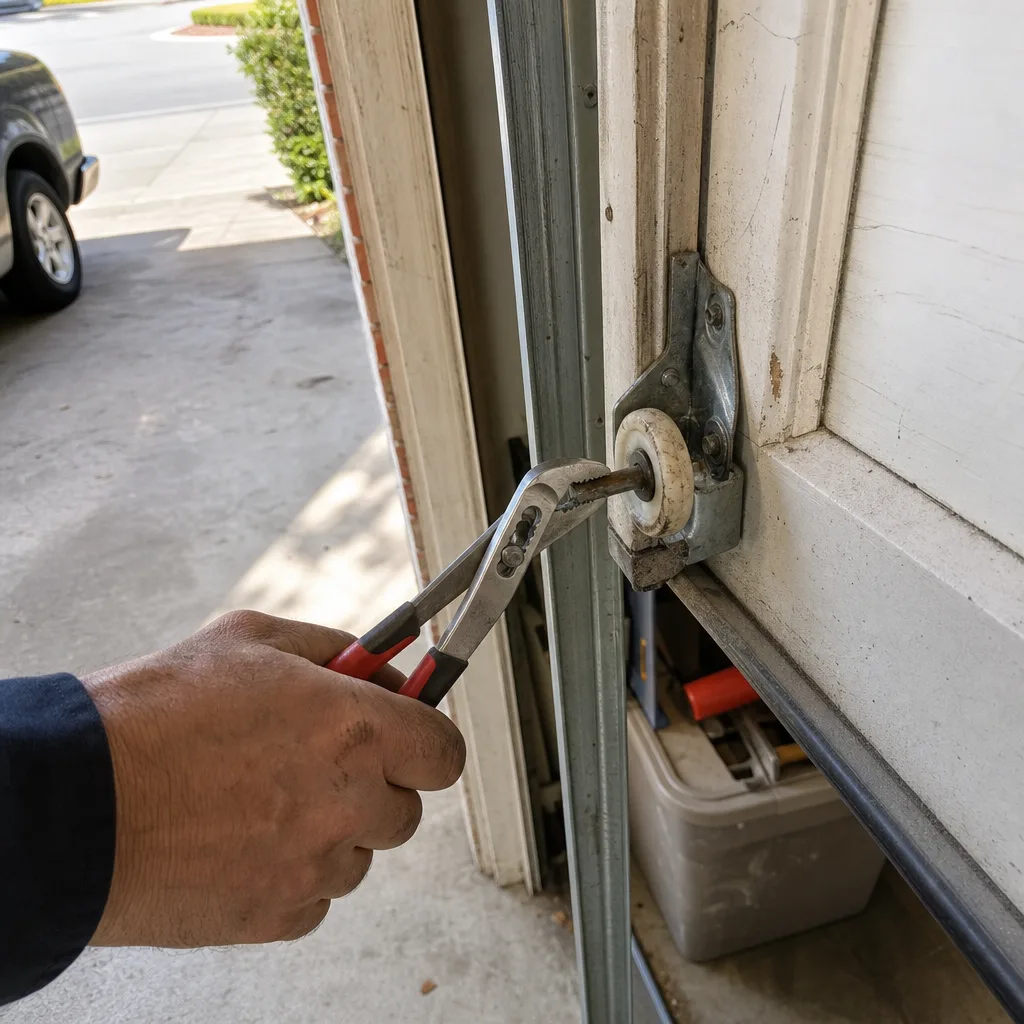
The wet season in Fremont isn’t about dramatic storms. It’s about persistent moisture, temperature differentials between outdoor fog and indoor garage air, and the electrochemical reaction that starts when water bridges two dissimilar metals. Here’s what to inspect, treat, and tighten.
What to Inspect Every 30 Days
- Bottom brackets and lower hinges. These are the lowest hardware points and collect condensation first. Look for white or greenish corrosion product, not just red rust. Aluminum oxidation looks white and chalky; galvanized steel corrosion looks white to gray. Either indicates active deterioration. Wipe clean and photograph.
- Roller stems and bearings. Steel rollers in aluminum tracks create another galvanic pair. Spin each roller by hand. It should turn freely with no grinding or catch. If the bearing feels gritty, moisture has entered. Replace before the roller seizes and tears the track.
- Weather seal contact pattern. Close the door and look at the floor seal from inside. The contact should be uniform across the full width. Gaps on the left or right indicate track shift from moisture-related foundation movement, common in Fremont’s clay-heavy soils in neighborhoods like Centerville and Niles.
- Opener rail and trolley carriage. Chain-drive openers accumulate condensation on the rail underside. Run the door and listen for chain slap or trolley chatter. Lubricate per manufacturer spec, not with WD-40, which displaces moisture but provides no lasting lubrication film.
What to Treat
Apply a lithium-based garage door lubricant to hinges, rollers, and springs every 60 days during the wet season. Avoid silicone sprays on the torsion spring; they attract dust and create an abrasive paste. For the spring, use a light machine oil or dedicated spring lubricant. Wipe excess from all surfaces; pooled lubricant traps moisture against metal.
If you find active corrosion on any hardware, do not paint over it. Painting traps moisture and accelerates hidden damage. Remove the component, clean to bare metal with a wire brush, and replace if pitting exceeds 1/32 inch depth. For bottom brackets, replacement is the only safe option; these components are under extreme tension and a corroded bracket is a sudden-failure risk. This is not a DIY repair. The torsion spring transfers its full load through the bottom bracket, and a failed bracket can release that energy without warning.
What to Tighten
Hardware loosens faster in wet-season conditions due to thermal cycling and, in Fremont’s case, minor seismic activity that most homeowners don’t notice. Check all lag screws into the header, track bolts, and opener mounting brackets with a socket wrench. Do not over-torque; snug plus a quarter turn is sufficient. Over-tightening strips wood headers and deforms track brackets.
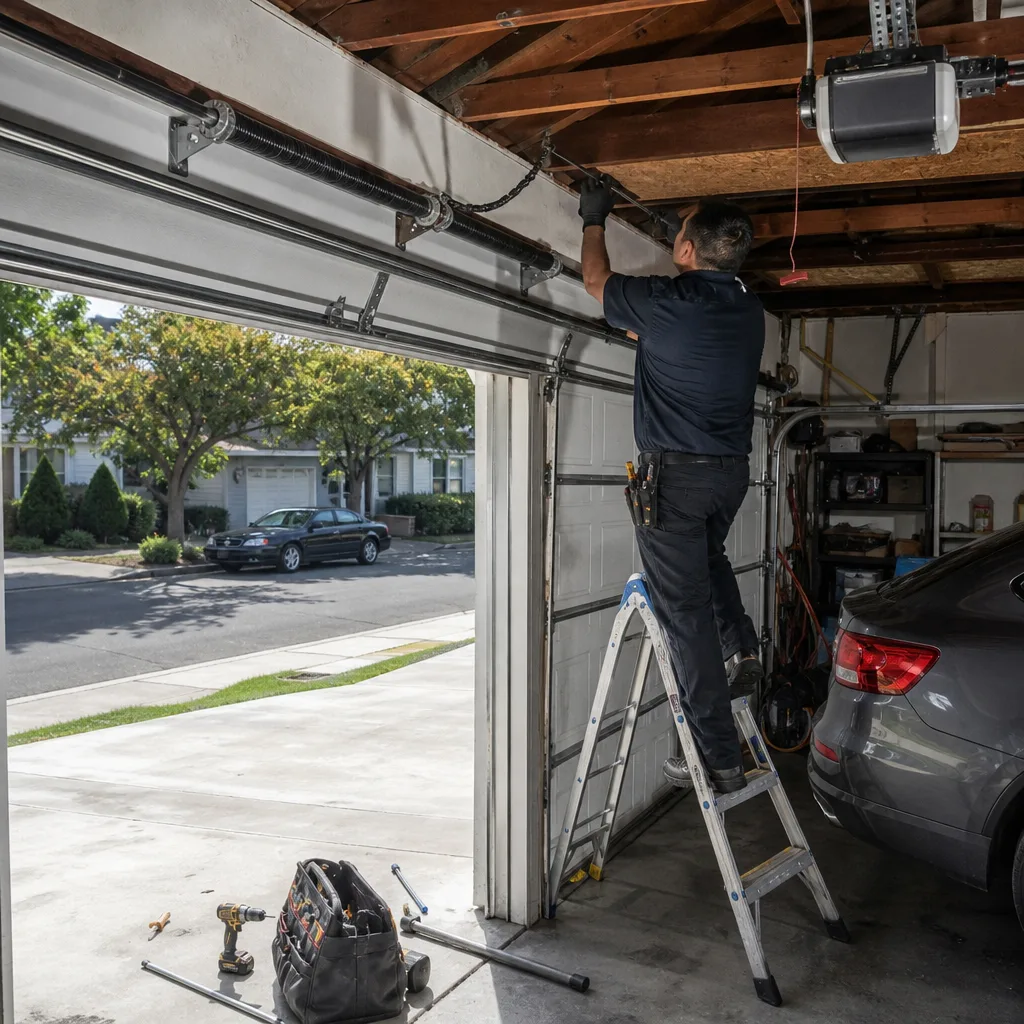
We’ve documented cases in the Glenmoor area where a single loose track bolt allowed 3/8 inch of roller wander, which in six months wore a groove in the track itself. The repair escalated from a $12 bolt to a $340 track replacement. Clause 4 of The Haven Standard is why our technician photographed the worn track before quoting; the customer saw the groove and understood why replacement was necessary, not suggested.
Dry Season Protocol: May Through October
When the marine layer retreats, Fremont’s garage interiors become solar ovens. The thermal effects on garage door systems are predictable but largely invisible until something fails. The dry season protocol focuses on spring tension calibration, thermal expansion effects on alignment, and dust infiltration into moving parts.
Torsion Spring Tension Drift
A torsion spring is a calibrated counterbalance. It is wound to a specific number of turns based on the door’s weight, drum circumference, and track radius. That calibration assumes a temperature range. In Fremont’s dry season, garage temperatures 30-40°F above the calibration point reduce the spring’s effective torque.
The symptom is subtle at first. The opener strains slightly more. The door may creep down from the open position instead of staying put. By late August, the safety reverse system may fail to lift the door when it contacts an obstruction, because the spring isn’t providing enough assist for the opener to reverse under load.
Homeowners can check balance with a simple test: disconnect the opener trolley (pull the red release handle), raise the door manually to waist height, and release. A properly balanced door stays put or drifts less than 6 inches. If it falls closed or shoots upward, the spring tension is out of calibration. In Fremont’s dry season, we see this condition most often in September, after four months of thermal degradation.
Spring adjustment is not a homeowner procedure. Torsion springs store lethal energy. A standard 16×7 steel door in Fremont typically uses a spring with 10,000+ inch-pounds of torque. The winding bars must be steel, inserted fully, and the technician must know the correct turns for the door’s specifications. Our garage door repair in Fremont includes tension calibration as a standard service item, with the before-and-after balance test documented in the photo record.
Track Alignment and Thermal Expansion
Steel tracks expand approximately 0.006 inches per foot per 10°F. For a 16-foot-wide door in a garage that cycles from 60°F to 100°F, that’s roughly 0.4 inches of total track movement. The track mounting system is designed to accommodate this, but only if the brackets are properly slotted and not over-tightened.
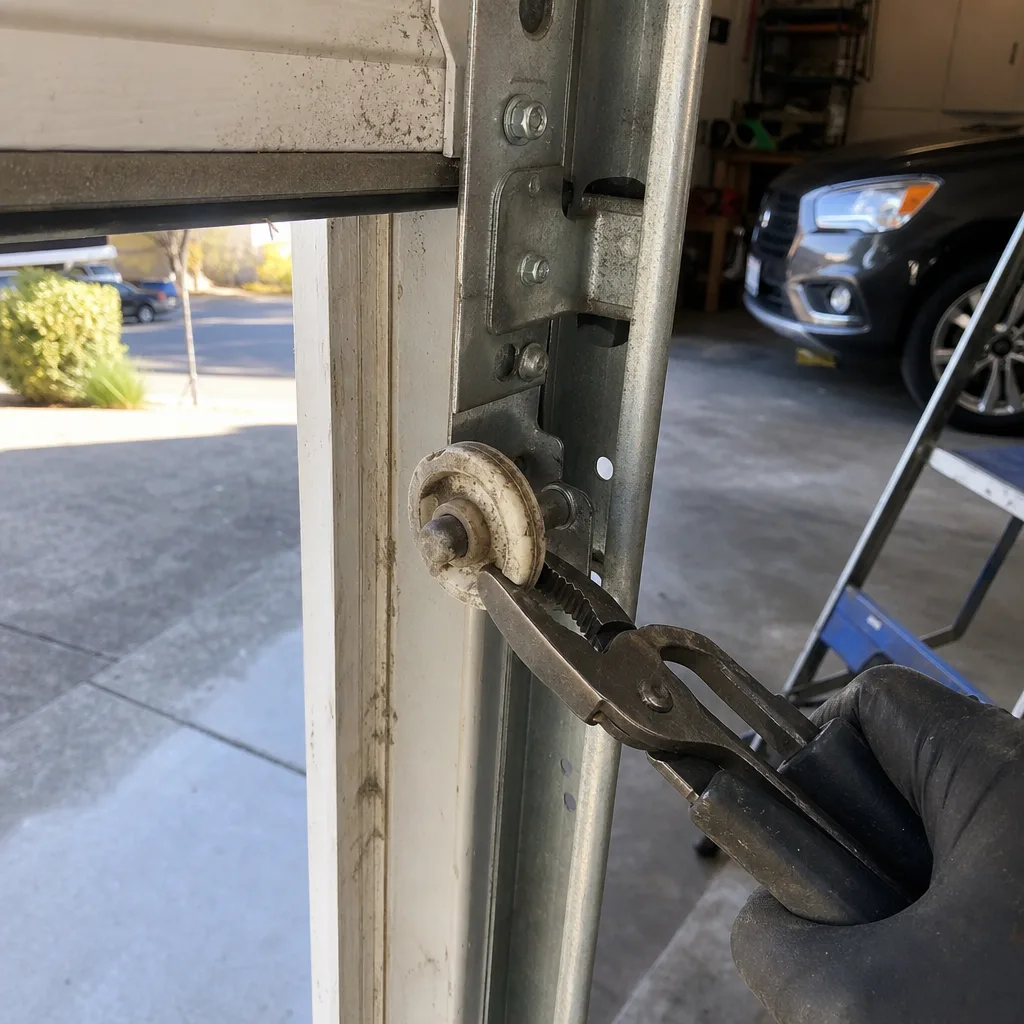
Check the vertical track-to-jamb brackets. The bolt should sit in the center of the slot, not at either end. If it’s at the end, thermal expansion has already taken up all available travel, and further expansion will distort the track or pull the bracket loose. This condition is common in older Fremont homes, particularly in the Irvington and Central District areas where original track hardware may be 20+ years old.
Dust and Lubricant Degradation
Dry season dust in Fremont is finer than most homeowners expect, a product of the Bay Area’s particulate mix that includes silica from the Diablo Range. This dust infiltrates roller bearings and opener gearboxes, mixing with lubricant to form an abrasive compound. By October, we’ve opened Genie and LiftMaster gear housings with paste consistency resembling valve grinding compound.
The maintenance response is straightforward: wipe accessible surfaces clean and re-lubricate in September, before the wet season begins. This timing matters. Fresh lubricant going into the wet season provides a moisture barrier; degraded lubricant going into the wet season traps moisture against metal.
The Altamont Wind Factor: What It Does to Your Door
Fremont sits downwind of the Altamont Pass, and several times each year, pressure gradients drive wind events through the Tri-City area that exceed 40 mph sustained. These aren’t Santa Ana conditions; they’re shorter, more localized, and they affect garage doors in a specific way that most homeowners don’t consider.
A sectional garage door is a large sail when closed. Wind pressure against the exterior face transfers through the panels to the track system, then to the jambs and header. The door is designed to handle this load in compression, but repeated cycling, especially when the wind direction shifts, creates a racking force that loosens track bolts and distorts panel alignment.
After any significant wind event, inspect the door from inside with it closed. Look for:
- Panel gaps that weren’t there before, especially at the meeting rails between sections
- Weather seal pulled away from the retainer on one side
- Track bolts that have rotated in their holes, indicating movement under load
- Opener arm bracket stress cracks at the top section attachment point
The neighborhoods most affected are those with direct Altamont exposure: the hills above Mission San Jose, the western edge of Warm Springs, and any home on the elevated terrain near Vargas Plateau. We’ve replaced wind-damaged Amarr and Clopay panels in these areas where the homeowner didn’t connect the wind event to the door damage until we showed them the stress patterns in the photo record.
For homes in exposed locations, consider a wind load-rated door at next replacement. These doors use heavier-gauge track, reinforced struts, and interlocking panel edges that resist racking. Garage door installation in Fremont for wind-exposed homes should always include a site-specific load calculation, not just a standard door in a standard opening.
Month-by-Month Task Calendar for Fremont
This calendar replaces the generic four-season template with Fremont’s actual climate drivers.
November: Wet Season Opening Inspection
- Photograph all hardware, weather seal, and panel condition for baseline documentation
- Apply fresh lithium lubricant to hinges, rollers, and opener rail
- Check bottom brackets and lower hinges for corrosion initiation
- Verify weather seal uniform contact with floor
- Test safety reverse system with a 2×4 board; door must reverse on contact
December through February: Monthly Monitoring
Every 30 days, re-inspect corrosion-prone points. Fremont’s heaviest fog typically arrives in January; this is when condensation is most persistent and corrosion accelerates. If you see active corrosion product forming between monthly checks, shorten the interval to two weeks. Document with dated photos.
March: Pre-Dry Season Preparation
- Clean all lubricant residue and reapply fresh coating
- Tighten all hardware to verified torque; replace any corroded fasteners
- Check track bolt position in slotted brackets; center if at extreme
- Schedule professional spring tension check if door showed balance drift in wet season
April: Transition Assessment
Photograph current condition. Compare to November baseline. Any change in hardware appearance, seal contact, or panel alignment should be noted. This is your documentation for any future service call.
May through August: Dry Season Monitoring
Monthly balance test: disconnect opener, raise door to waist height, release. Note drift direction and distance. If the door falls closed with increasing speed as summer progresses, spring tension is thermally degrading. Schedule calibration before the opener fails under overload.
September: Pre-Wet Season Service
- Clean and re-lubricate all moving parts
- Replace any dust-contaminated lubricant in opener gearbox (professional service)
- Final dry-season balance test; document results
- Inspect weather seal for UV degradation; replace if cracked or stiffened
October: Final Documentation
Photograph full door condition. Compare to April photos. This completes the annual record cycle. Store all photos with dates in a dedicated folder; they establish pre-existing condition for any insurance or warranty claim.
How to Document Seasonal Condition (And Why It Matters)
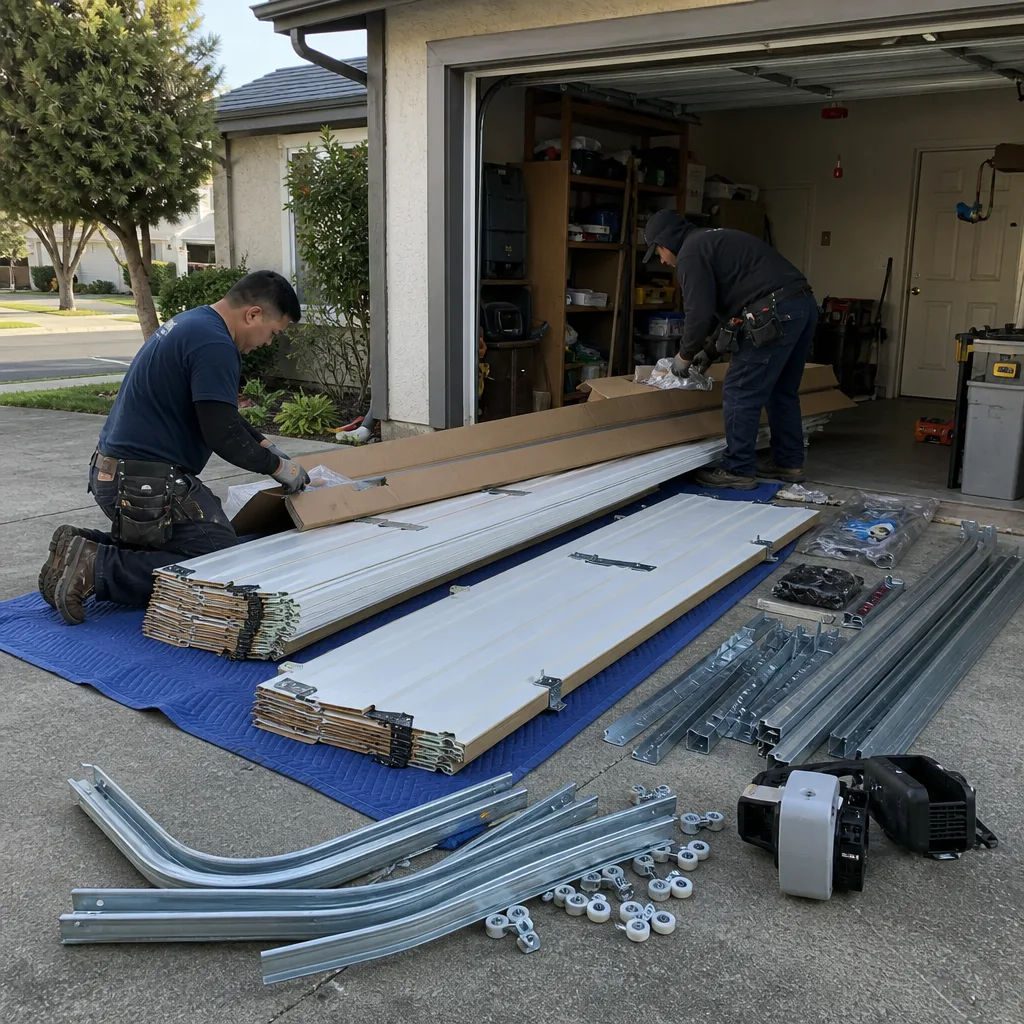
The photo record is not a nice-to-have. It is the difference between a warranty claim that processes and one that stalls, between a service call that resolves in one visit and one that requires a callback because the technician couldn’t determine what changed when.
At Servo Garage Doors Fremont, every visit closes with a documented photo record delivered to the customer. This traces to our founding rule, now Clause 4 of The Haven Standard: the customer sees the failed part before anyone quotes a replacement. But homeowners can and should maintain their own seasonal documentation between professional visits.
What to Photograph
- Full door exterior and interior, closed position, from centerline
- Each bottom bracket from below, showing fastener condition and corrosion status
- Lower hinge set (typically hinges #1 and #2) in close-up
- Weather seal contact with floor, from inside, with door closed
- Track-to-jamb bracket bolt position in slot
- Opener rail and trolley carriage, full length
- Any anomaly: new noise, visible wear, changed movement pattern
How to Organize
Use a consistent naming convention: YYYY-MM-DD_Location_Description. Example: 2024-11-15_Fremont_BottomBracket_Left.jpg. Store in cloud backup, not solely on a phone that can be lost or damaged.
Why This Matters for Service Calls
When a technician arrives to a door that “just started making noise,” the first question is what changed. Without documentation, the answer is guesswork. With dated photos, the technician can compare current condition to prior state, identify the specific component that degraded, and quote accurately for repair rather than exploratory disassembly.
This documentation also protects the homeowner. If a new noise develops after a wind event, dated photos showing pre-event condition support an insurance claim for wind damage. If a warranty issue arises with a Genie or LiftMaster opener, the photo record establishes that installation was correct and maintenance was performed.
We’ve used customer-provided seasonal photos to resolve disputes that would otherwise have required two visits. In one Fremont case, a homeowner’s November-to-March photo sequence showed progressive corrosion on a bottom bracket that we had flagged as watch-condition in a prior service. When the bracket failed in April, the warranty replacement was approved in minutes because the deterioration was documented, not alleged.
Common Mistakes to Avoid
- Using WD-40 as a garage door lubricant. WD-40 displaces moisture but evaporates within days, leaving metal unprotected. It also strips existing lubricant. Use lithium-based garage door lubricant or light machine oil.
- Ignoring the marine layer because “it doesn’t rain much in Fremont.” Rain volume is irrelevant; condensation frequency drives corrosion. A garage that sees fog three mornings per week accumulates more moisture damage than one with occasional heavy rain.
- Adjusting torsion spring tension after watching a video. The tools and techniques shown in online tutorials are often incorrect for your specific door weight and drum configuration. Incorrect winding can spring the bars loose with lethal force.
- Assuming a door that opens is a door that’s fine. Openers compensate for degraded springs, misaligned tracks, and worn rollers until they can’t. The failure is sudden and usually at the worst possible time. Monthly balance tests catch degradation before failure.
- Skipping documentation because “I’ll remember what it looked like.” You won’t. Neither will the next homeowner if you sell. Dated photos are objective evidence; memory is reconstruction.
- Using the same maintenance schedule as a friend in Sacramento or San Jose. Sacramento’s dry heat and San Jose’s different fog patterns create different failure modes. Fremont’s specific position relative to the Bay and the Altamont Pass produces a unique moisture-and-wind profile.
- Delaying service until the door fails completely. A door that won’t open traps vehicles, compromises security, and often costs more to repair because secondary damage occurs when the primary failure stresses remaining components.
When to Call a Professional
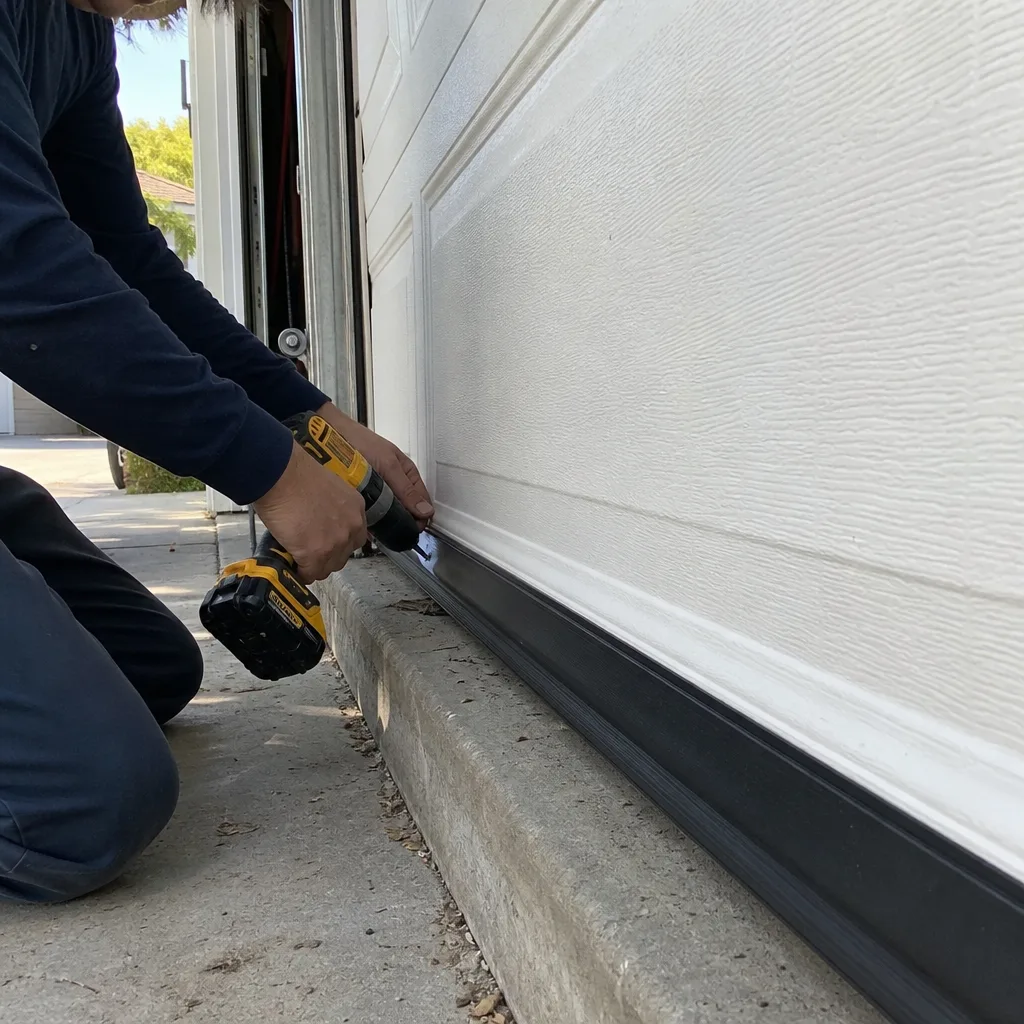
Some conditions require trained diagnosis and specialized tools. Call for service when you observe any of the following:
- Door falls closed during balance test or rises from the closed position uncommanded
- Visible gap between coils of a torsion spring, indicating a broken inner strand
- Corroded or cracked bottom bracket, or any hardware deformation
- Opener motor hums but door doesn’t move, or moves with grinding noise
- Panel damage from impact or wind, including dents that affect section alignment
- Safety reverse system fails testing with a 2×4 board or manufacturer-specified object
- Any condition you documented that has visibly progressed since last inspection
Servo Garage Doors Fremont offers free estimates in Fremont. Call (669) 333-7846. A live person answers, including for emergency garage door calls, and you’ll receive a named technician with an on-the-way text, not a callback window. Every quote is flat, written, and delivered before any work starts, per Clause 1 of The Haven Standard. The 365-Day Done Right Promise means if a repair is not right, we make it right, backed by terms, not a handshake.
Frequently Asked Questions
Every 60 days during the wet season (November through April) and once in September before the wet season begins. The dry season’s dust contamination degrades lubricant by late summer, so fresh application before moisture returns provides maximum protection. Use lithium-based garage door lubricant, not WD-40. Call (669) 333-7846 if you’re unsure which product is appropriate for your door’s hardware.
Torsion springs lose effective tension as temperature rises. A door balanced at 70°F may run 15-20 pounds heavy in a 100°F garage. This is normal physics, not spring failure, but the increased load accelerates opener wear and can disable the safety reverse system. Have spring tension checked and recalibrated if the balance test shows more than 6 inches of drift. We document the before-and-after balance in every service photo record.
Yes. Condensation from marine layer fog creates galvanic corrosion where dissimilar metals contact, particularly aluminum door skins with steel hinges and brackets. The corrosion product often looks cosmetic but can reduce cross-section by 30% before visible failure. Monthly inspection and fresh lubricant application during fog season prevents most of this damage.
A professional tune-up including lubrication, hardware torque verification, balance test, safety system check, and documented photo record typically runs $89-$149 in the Fremont market. Repairs found during inspection are quoted separately with flat, written pricing before any work begins. We do not charge diagnostic fees in addition to the tune-up when service proceeds. Call (669) 333-7846 for current scheduling.
Not automatically. A well-maintained door with documented service history often appraises as well as a new door with unknown maintenance. If the door is pre-2000, shows panel damage, or lacks modern safety features, replacement may be justified. Garage door installation in Fremont for sale prep should include a door with current wind load rating and insulated construction, which buyers in this market increasingly expect. We provide free estimates and a written scope for any replacement.
Battery backup (required by California law for new installations since 2019), soft start/stop to reduce wear on thermally stressed springs, and a steel-reinforced belt or chain for wind load resistance. For homes with garage door opener repair and installation in Fremont, we recommend models with onboard diagnostic displays that report cycle count and force settings, useful for tracking seasonal degradation. We service all major brands including Genie, LiftMaster, and Chamberlain.
No. Our flat, written price and written scope are delivered before any work starts, per Clause 1 of The Haven Standard. The only exception is if you authorize additional work beyond the original scope. Even then, the additional work is quoted separately and requires your approval before proceeding. The price you agree to is the price on the invoice.
The Bottom Line
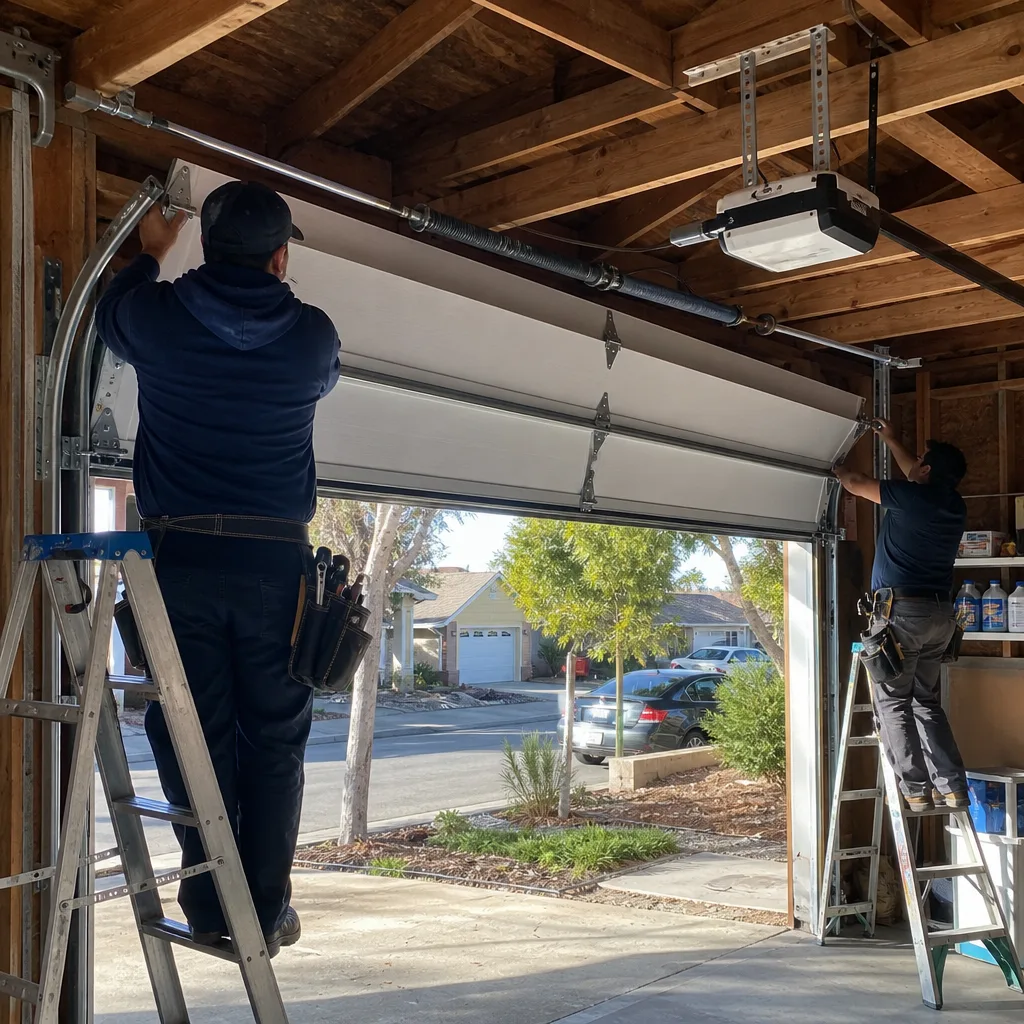
Fremont’s garage doors don’t fail because of dramatic weather. They fail because a marine layer nobody talks about corrodes hardware slowly, and summer heat nobody prepares for degrades spring tension predictably. The homeowners who avoid emergency repairs are the ones who inspect monthly, lubricate on schedule, document with dated photos, and understand that their door needs different care in November than it does in July. The cost of this attention is a few hours per year and occasional professional tune-up. The return is a door that opens when you press the button, closes securely when you leave, and never strands a vehicle in the driveway because a bottom bracket nobody inspected finally snapped.
For a free estimate on seasonal maintenance, spring calibration, or any garage door concern in Fremont, call (669) 333-7846. Calls are answered live, 24 hours a day, including holidays. Every visit includes a flat written price before work starts and a documented photo record when the technician leaves, per The Haven Standard. The 365-Day Done Right Promise applies to every repair.
Written by Marcus Deller, Owner at Servo Garage Doors Fremont, serving Fremont since 2015.