
Last updated September 21, 2026
Full 25-point door and opener safety check with every visit - springs, cables, rollers, tracks, and your LiftMaster or Chamberlain opener included
You get a price before we start. It does not change when the truck arrives.
How to Hire a Garage Door Contractor in Fremont: A Step-by-Step Guide
California requires garage door contractors to carry a C-61/D28 Limited Specialty license, but the CSLB license lookup takes 90 seconds and fewer than 20% of Fremont homeowners run it before scheduling. That means most people vet a contractor less carefully than they vet a restaurant. In this guide, we’ll show you the exact license to verify, the five questions that disqualify half the contractors who answer your call, and why a written price with a photograph of the failed part beats every Yelp review combined. For more guides & resources, visit our blog.
Quick Answer
To hire a garage door contractor in Fremont, verify their C-61/D28 license at cslb.ca.gov, demand a written quote with part numbers and labor hours before any work starts, and ask whether they photograph the failed component before quoting. Any contractor who quotes by phone, pressures you during the visit, or won’t put the scope and price in writing is a disqualification.
Table of Contents
- Step 1: Verify the C-61/D28 License (90 Seconds)
- Step 2: Ask These Five Questions Before Booking
- Step 3: Demand a Written Quote With Part Numbers
- Step 4: Insist on Photographing the Failed Component First
- Fremont-Specific Red Flags to Watch For
- Common Mistakes to Avoid
- When to Call a Professional
- Frequently Asked Questions
Step 1: Verify the C-61/D28 License (90 Seconds)
The Contractors State License Board (CSLB) issues a specific classification for garage door work: C-61/D28, the Limited Specialty for Garage and Overhead Door. Not a general B license. Not a handyman exemption. C-61/D28. This matters because a general contractor can legally subcontract your job to an unlicensed installer, and in Fremont’s building department, that creates liability you don’t want.
Here’s the 90-second lookup:
- Go to cslb.ca.gov and click “Check a License.”
- Enter the company name or the six- or seven-digit license number.
- Read three fields carefully:
- Status: Must read “Active.” “Suspended” or “Delinquent” means stop.
- Classification: Must include C-61/D28 or C-10 (electrical, for opener wiring). A B-General Building alone is insufficient for garage door-specific work.
- Workers’ Compensation: Required if the company has employees. “Exempt” with multiple trucks is a red flag.
- Click “Bond History” to confirm a current $25,000 contractor’s bond.
In Fremont, we’ve seen homeowners burned by crews operating under a relative’s expired license or a general B classification that doesn’t cover torsion spring calibration. The C-61/D28 holder has passed a trade-specific exam on door balance, spring tension, and safety hardware. That’s the minimum competence floor, not a high bar.
One more field to check: “Disciplinary Actions.” Even a settled complaint leaves a public record. In our experience, a contractor with multiple disciplinary entries in the last five years correlates with the same patterns we see in disputed jobs: verbal quotes that balloon, parts swapped without documentation, and warranty claims ignored.
Step 2: Ask These Five Questions Before Booking
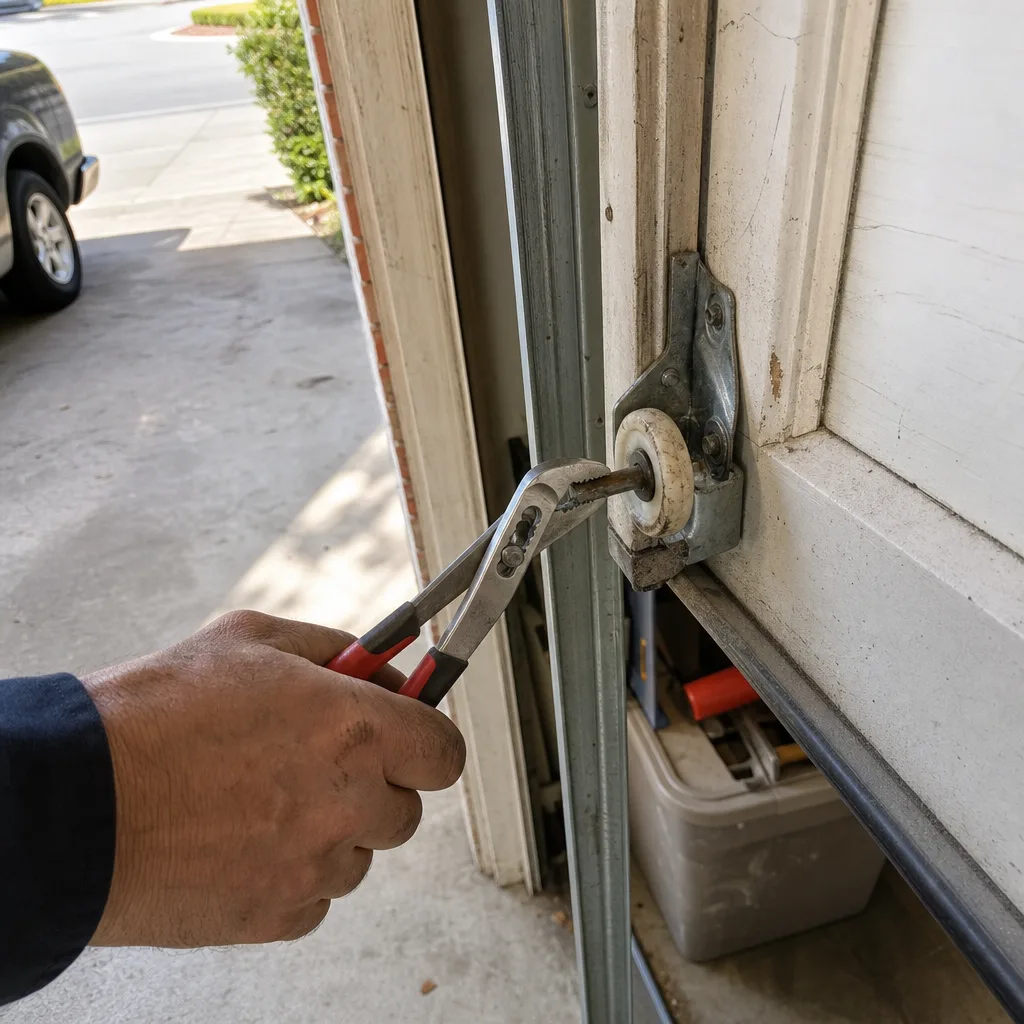
These five questions filter out contractors who rely on urgency and opacity. The wrong answer to any one is a disqualification. Write down the answers. Compare them.
Question 1: “Will you put the full scope and price in writing before any work starts?”
The only acceptable answer is yes, with specifics. A written quote must include: the part number or description of each component, labor hours or flat labor rate, and the total. “We’ll see when we get there” is a disqualification. At Servo Garage Doors Fremont, Clause 1 of The Haven Standard requires a flat, written price and written scope before any work begins. No exceptions. The customer signs it, the technician signs it, and both keep a copy.
Question 2: “Do you photograph the failed component before quoting replacement?”
This separates documentation-based contractors from trust-me contractors. The technician should show you the cracked torsion spring, the stripped gear on the logic board, or the bent track section, then quote based on that evidence. At Servo, Clause 4 of The Haven Standard codifies this: the customer sees the failed part before anyone quotes a replacement. The photo record becomes part of the job file. If a contractor says “I can tell from here” or “you don’t need to see it,” that’s a disqualification.
Question 3: “What does your warranty cover, and where is it written?”
Verbal warranties are unenforceable. The warranty must specify: duration, what components are covered, whether labor is included, and the process for claims. Our 365-Day Done Right Promise is documented on a terms page, not a handshake. Ask to see the warranty document before booking. If they don’t have one, or if it’s “satisfaction guaranteed” with no definitions, that’s a disqualification.
Question 4: “Are your technicians employees or subcontractors?”
Subcontractor crews are common in garage door work. They’re paid per job, incentivized to finish fast, and often uninsured under the company’s workers’ comp policy. Employees in uniform, with background checks and W-2 documentation, are accountable to the company that answers your call. At Servo, every technician is a background-checked, uniformed employee. The license number is on the page, not buried in fine print.
Question 5: “What happens if the price needs to change mid-job?”
The honest answer: it shouldn’t, if the diagnosis was done correctly. A written quote with part numbers and labor hours should be complete. If a contractor discovers additional damage, they should stop, document it, and present a revised written scope before continuing. “Additional parts if needed” clauses without dollar caps or part descriptions are how $200 quotes become $800 invoices. Ask what the clause specifically permits. Vague language is a disqualification.
Step 3: Demand a Written Quote With Part Numbers
A written quote is only as good as its specificity. Here’s what must appear for the document to be enforceable and comparable:
- Part numbers or exact descriptions: “Torsion spring, 0.250 x 2.00 x 32.00, left wound” not “new spring.” For openers: “LiftMaster 84501, 1/2 HP DC belt drive” not “new opener.”
- Labor hours or flat labor rate: “2.5 hours at $X/hour” or “Flat labor: $Y for spring replacement.” Vague “labor” line items are unverifiable.
- Permit fees if applicable: In Fremont, new garage door installations require a building permit through the city’s Community Development Department. The quote should state whether permit fees are included or separate.
- Total price with expiration date: Quotes expire. Material costs change. A 30-day expiration is standard.
- Signature lines for both parties: Both the customer and the technician or company representative sign. This creates mutual commitment.
The “additional parts if needed” clause deserves special scrutiny. This is where disputes breed. A proper clause specifies: the maximum additional dollar amount, the specific conditions that trigger it (e.g., “if the bottom bracket is cracked upon visual inspection”), and that the customer must approve the addition in writing before work continues. Anything broader is a blank check.
In Fremont’s climate, with salt air influence from the Bay and thermal cycling between summer heat and winter fog, we see more corrosion on bottom brackets and hinge points than inland contractors do. Our Seasonal Garage Door Care for Fremont: Year-Round Homeowner’s Guide covers how to stay ahead of these issues. A quote that doesn’t account for this, or that leaves hardware replacement open-ended, is a quote that will likely grow. Specificity protects both parties.
Our Free Second Opinion offer applies to any competing written estimate a customer brings in. No coupon or code is required. We review the part numbers, the scope, and the pricing, and we tell you where the gaps are.
Step 4: Insist on Photographing the Failed Component First
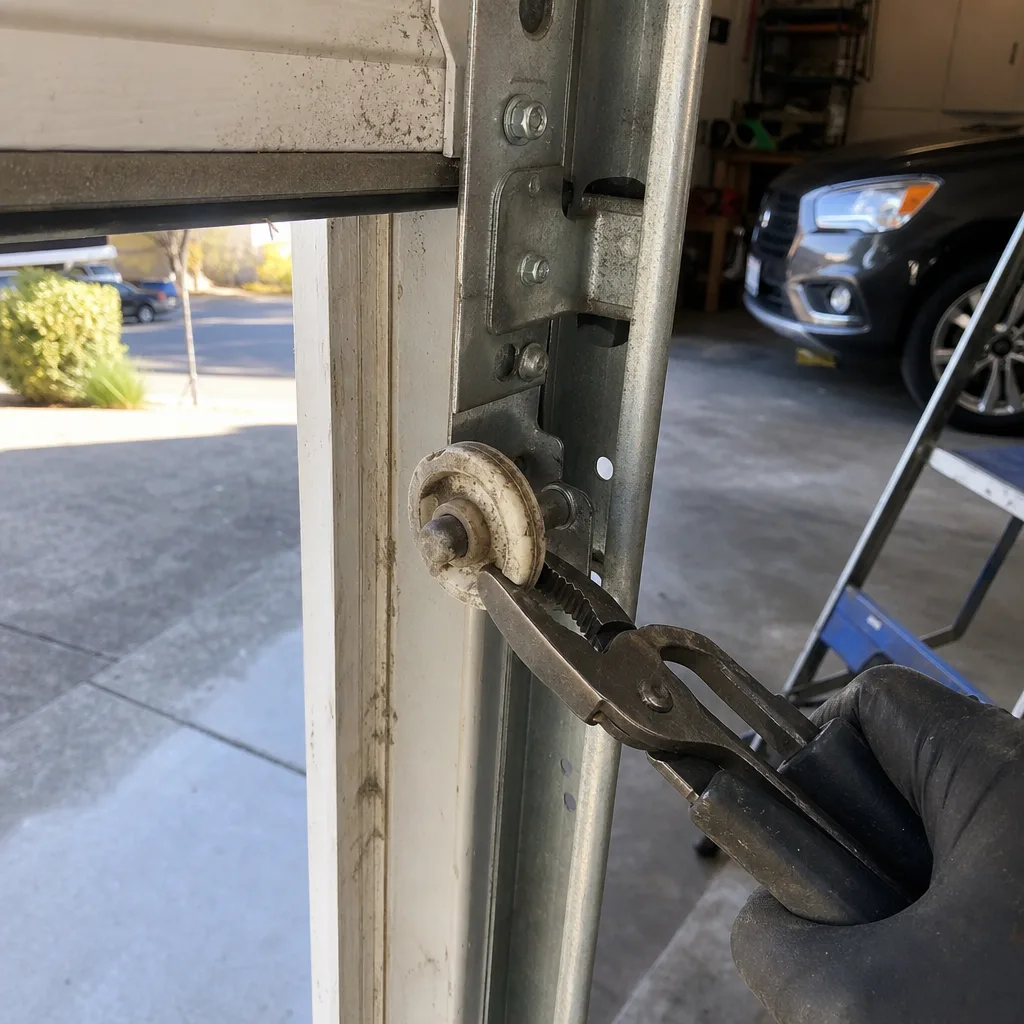
This practice sounds like customer service. It’s actually fraud prevention and dispute elimination.
Here’s how it works when done correctly: the technician arrives, inspects the door system, identifies the failed or failing component, and photographs it with the customer’s phone or their own device. The customer sees the crack in the torsion spring, the wear pattern on the trolley carriage, or the corrosion on the bottom bracket. Then the quote is written. The photograph creates a timestamped record of the pre-existing condition. After repair, the technician photographs the installed component. The customer receives both images.
This matters because:
- It eliminates he-said-she-said: The photo proves what was there. No memory disputes six months later.
- It prevents unnecessary replacement: A customer who sees a clean break in a spring understands why replacement is necessary. A customer told “your spring is worn” without evidence has no basis to evaluate the claim.
- It creates accountability for installation quality: The after photo shows proper winding, correct hardware placement, and clean workmanship.
At Servo, this traces to our founding rule from 2015: the customer sees the failed part before anyone quotes a replacement. Clause 4 of The Haven Standard now codifies it. We’ve completed 18,000+ garage doors made right since then, every one with a written price before work started and a documented record when the technician left.
A contractor who won’t photograph the component is asking you to trust their verbal assessment of a mechanical system you likely can’t evaluate yourself. That’s not a relationship of equals. It’s a power imbalance that predictably produces disputes.
Fremont-Specific Red Flags to Watch For
Fremont’s housing stock, market dynamics, and geographic position create specific risks that don’t apply uniformly across the Bay Area.
Door-to-Door Spring Replacement Offers
Crews canvassing neighborhoods like Mission San Jose, Warm Springs, and the Irvington district with “we’re in the area” spring replacement specials are a persistent issue. They target the visible symptom (a broken spring) with a flat rate that excludes hardware, rebalancing, and safety cable inspection. The CSLB has issued multiple warnings about traveling door-to-door repair operations. Legitimate garage door contractors in Fremont do not solicit door-to-door.
Quotes Given by Phone Without Inspection
A torsion spring replacement can range from $180 to $340 depending on wire diameter, inside diameter, length, and whether the door has one or two springs. A phone quote of “$199 any spring” is either a loss leader with hidden add-ons or a sign that the contractor plans to swap in whatever spring is on the truck regardless of specification. Proper spring selection requires measuring the existing spring or weighing the door. This takes 10 minutes on site. Any quote given without this measurement is unreliable.
Add-On Pressure During Service Visits
The technician arrives for a spring replacement, then “discovers” that the rollers are worn, the cables are frayed, and the opener is “struggling.” Some of these may be genuine. The red flag is the pressure: “I can do it all today for a discount, but I need to know now.” This creates artificial urgency that overrides careful evaluation. A proper contractor documents each finding with a photo, provides a separate written quote for each additional item, and lets the customer schedule it later without penalty.
“We Handle the Permit” Without Showing It
Fremont requires building permits for new garage door installations. Some contractors promise to “take care of it” but never file, leaving the homeowner with an unpermitted installation that complicates future sale or insurance claims. Ask for the permit application number and verify it with Fremont’s Community Development Department.
Generic Parts on Branded Doors
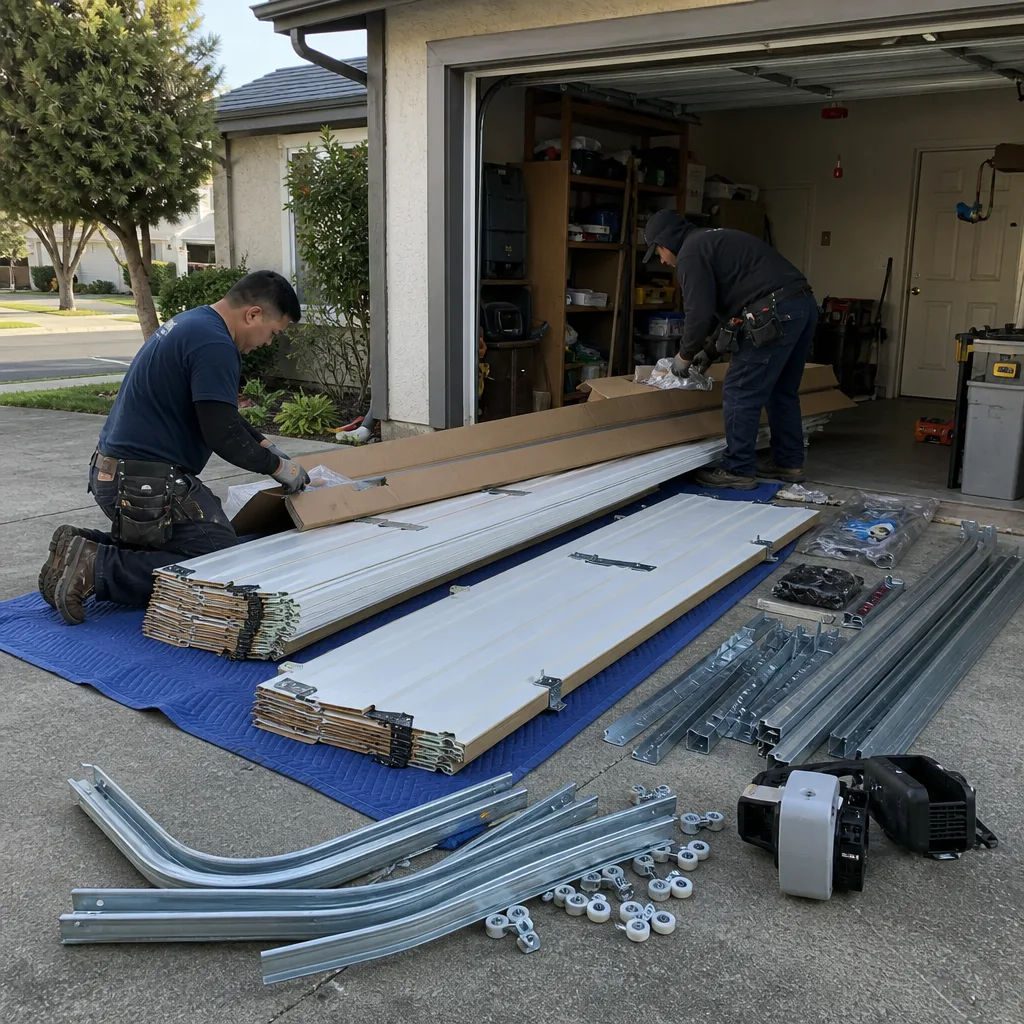
Fremont has a high concentration of homes built between 2015 and 2025 with Clopay and Amarr doors installed by the builder. These doors have specific hinge geometries, track radii, and spring specifications. A contractor who installs generic hinges or mismatched track hardware creates alignment problems that manifest as noisy operation and premature wear. Ask whether the proposed parts are OEM or equivalent specification.
Common Mistakes to Avoid
- Verifying only the company name, not the license number. Company names change, dissolve, and reconstitute. The license number is the persistent identifier. Always verify the number.
- Accepting “licensed and insured” without documentation. Ask for the certificate of insurance naming you as additional insured for the project duration. “We’re insured” is not proof.
- Comparing quotes without matching scope. A $180 spring replacement with no safety cable and no rebalancing is not comparable to a $280 replacement with new cables, end bearings, and door weight verification. Line-item comparison is essential.
- Ignoring the permit requirement for installations. Fremont’s building department enforces permit compliance for new door installations. Skipping it saves $200-400 upfront and costs far more at sale or after a failure.
- Booking based on availability speed alone. Same-day service is appropriate for emergencies (door stuck open, vehicle trapped). For non-urgent repairs, a 24-48 hour wait for a contractor who documents properly beats same-day service from one who doesn’t.
- Not checking the CSLB complaint history. A license in good standing with three settled complaints in two years tells a different story than a clean record.
- Paying in full before work is complete and documented. The final payment should follow your review of the completed work and receipt of the photo record, written warranty, and final invoice matching the quoted scope.
When to Call a Professional
Some garage door issues are maintenance items a homeowner can handle - see our Complete Guide to Garage Door in Fremont for details - including lubricating hinges and rollers with silicone-based spray, clearing track debris, and testing the photo-eye alignment. Others require professional intervention because they involve stored mechanical energy or electrical components that can cause serious injury.
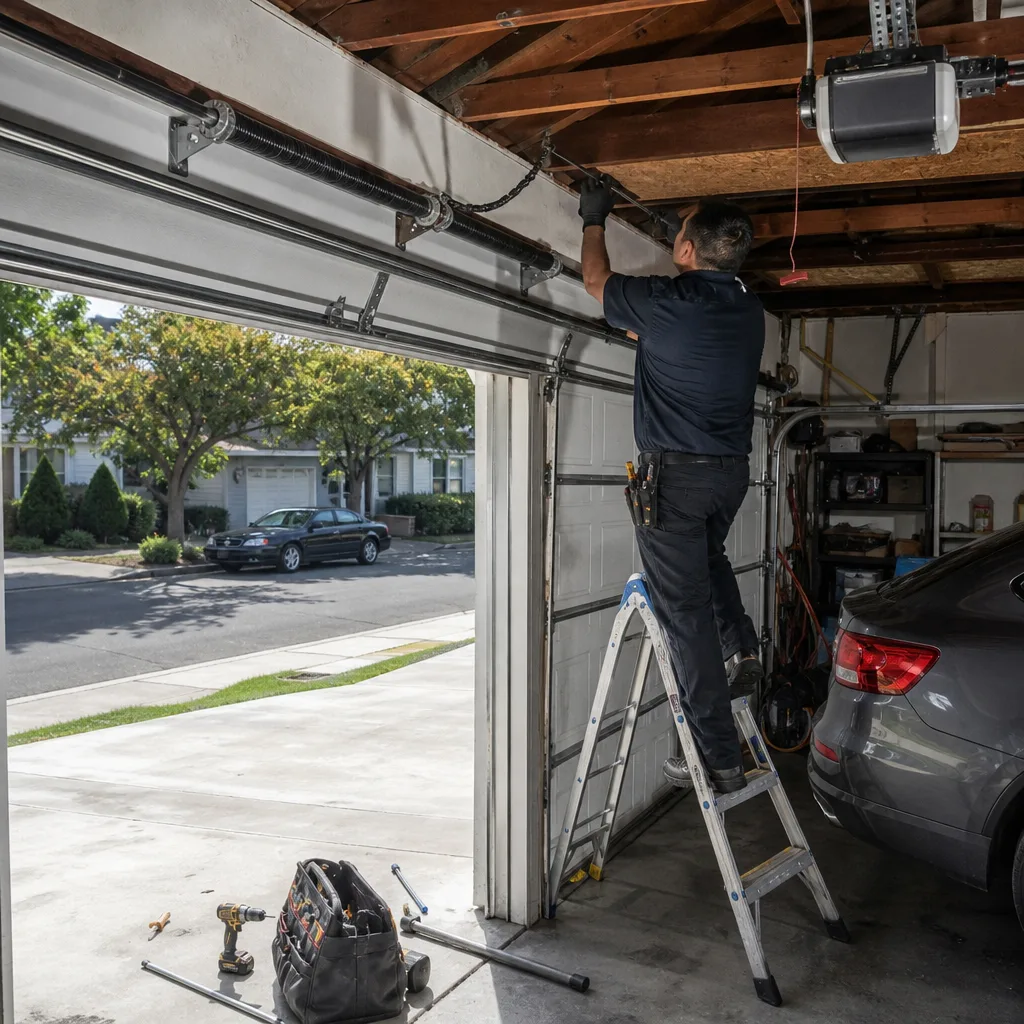
Call a professional for: broken torsion or extension springs (high-tension components that can cause severe injury or death if handled improperly), cables that have come off the drum, opener logic board failures, bent or misaligned track sections, and doors that have come off the rollers entirely. These scenarios involve forces or electrical systems that exceed safe DIY scope.
Servo Garage Doors Fremont offers free estimates in Fremont. Our technicians arrive with the documentation system described in this guide: written price first, photograph of the failed component, and a completed photo record before they leave. For garage door repair in Fremont, garage door installation in Fremont, or garage door opener repair and installation in Fremont, call (669) 333-7846. Emergency calls are answered by a live person, 24/7, with a named technician and an on-the-way text.
Frequently Asked Questions
Spring replacement typically runs $180-$340, opener repairs $150-$400 depending on whether the logic board or motor is involved, and cable or roller replacement $120-$250. New garage door installations in Fremont range from $1,200 for a basic steel door to $3,500+ for insulated carriage-house styles with windows. Call (669) 333-7846 for an exact quote - estimates are free.
Visit cslb.ca.gov, click “Check a License,” and enter the six- or seven-digit license number. Verify the status is “Active,” the classification includes C-61/D28, and workers’ compensation coverage is current if the company has employees. The entire lookup takes under 90 seconds.
A written estimate must include: specific part numbers or exact descriptions, labor hours or flat labor rate, total price with expiration date, and signature lines for both parties. Vague line items like “spring” or “labor” without quantities or rates are unenforceable and uncomparable.
Torsion springs store lethal amounts of mechanical energy. Winding bars can slip, springs can break during installation, and improper tensioning causes the door to fall or fly open. We do not recommend DIY spring replacement. A trained technician has the winding bars, vise grips, and knowledge of spring geometry to do this safely. For your safety, call a professional.
Phone quotes allow contractors to lowball to get in the door, then raise the price on arrival. Proper spring selection requires measuring wire diameter, inside diameter, and overall length, or weighing the door. This cannot be done accurately by phone. Any contractor who quotes a firm price without inspection is either guessing or planning to change it later.
For emergency repairs - door stuck open, vehicle trapped, security concern - same-day service is available from established Fremont contractors including Servo. For non-urgent repairs and installations, 24-48 hour scheduling is standard. Speed should not override documentation quality. A properly documented repair beats a rushed one every time.
The Bottom Line
Hiring a garage door contractor in Fremont is not about finding the lowest price or the fastest arrival. It’s about finding a contractor who will show you the evidence, put the scope and price in writing before touching anything, and leave you with documentation of what was found and what was done. The C-61/D28 license is the floor. The photograph of the failed component, the written quote with part numbers, and the documented warranty are what separate a transaction you can verify from a promise you can’t enforce. Run the 90-second license check. Ask the five questions. Compare written scopes, not verbal assurances. The contractor who welcomes this scrutiny is the one worth hiring.
Written by Marcus Deller, Owner at Servo Garage Doors Fremont, serving Fremont since 2015.